
Library
Using Mimosa Hostilis for Eco-Friendly Wood Staining and Furniture Restoration
Last updated: 3 July, 2026
Quick Answer
Mimosa hostilis root bark (Mimosa tenuiflora) contains roughly 16% tannin by weight, mostly in the form of condensed proanthocyanidins.Chemical analysis of genuine tepescohuite bark has confirmed that tannins make up the major component group, at a concentration of about 16 percent, composed mainly of proanthocyanidins. Simmered in water, this bark releases a reddish-brown to purple pigment that penetrates raw or stripped wood, produces color without synthetic dyes, and — because tannins bind to lignin and resist fungal breakdown — offers a measure of natural rot resistance as a side effect of the staining process. It is a low-toxicity, biodegradable alternative to petroleum-based wood stains, best suited for interior furniture, decorative pieces, and restoration projects where the wood will be sealed with a separate topcoat for durability.
What Is Mimosa Hostilis?
Mimosa hostilis is the common trade name for Mimosa tenuiflora (Willd.) Poir., a thorny, fast-growing leguminous tree native to the semi-arid Caatinga region of northeastern Brazil and parts of southern Mexico and Central America. It is known locally by several names — jurema preta in Brazil, tepezcohuite in Mexico — and has been used by indigenous communities for centuries in wound care, leatherworking, and textile dyeing.
The wood itself is valued as a fuel source and for making posts, largely because its high tannin content protects it from rot, and because of that same tannin content the bark is widely used as a natural dye and in leather production, appearing in bridges, fences, furniture, and wheels. That last detail matters for this guide: Mimosa hostilis is one of the few dye plants with a documented history in structural and furniture-grade woodworking, not just textiles.
The part used for staining is the root bark (often sold as MHRB — Mimosa Hostilis Root Bark), harvested, dried, and either shredded or ground into powder. The inner layer of the bark carries the deepest pigment concentration.
The Chemistry Behind the Color: What the Research Actually Shows
Most online websites about Mimosa hostilis repeats the same claims without sourcing them. Here is what peer-reviewed research actually documents.
Tannin content and composition
A pharmacognostical study published in the Journal of Ethnopharmacology analyzed bark samples collected in Chiapas, Mexico, to establish quality-control standards for the plant drug. The researchers found tannins to be the dominant chemical group in the bark, present at roughly 16 percent concentration and composed primarily of proanthocyanidins — a finding solid enough that it now serves as a chemical fingerprinting method for authenticating genuine material. Proanthocyanidins are condensed tannins built from flavan-3-ol subunits; they are the same broad chemical family responsible for the color and astringency in red wine, tea, and grape seed extract.
A 2022 systematic review of Mimosa genus phytochemistry cross-referenced multiple studies and confirmed that the condensed tannins in M. tenuiflora bark have procyanidin and prodelphinidin units as their principal active components. These are the same oligomeric structures that give the bark its strong affinity for binding proteins and cellulose — the mechanism that makes it effective both as a leather tanning agent and as a wood-penetrating dye.
Why this matters for wood
Wood is composed largely of cellulose, hemicellulose, and lignin. Condensed tannins are polyphenolic molecules with multiple hydroxyl groups, which allows them to form hydrogen bonds with the hydroxyl groups in cellulose and to chelate with metal ions present in mordants. This dual bonding capacity is what allows tannin-based dyes to penetrate wood fiber rather than simply sitting on the surface, and it is also the reason tannin extracts have been studied independently as wood preservatives, separate from their use as colorants.
Tannins as a Natural Wood Preservative: The Supporting Research
Because furniture restoration is not just about color but about longevity, it’s worth looking at the broader scientific literature on tannins and wood durability — most of it conducted on related tannin-rich species rather than Mimosa specifically, but directly relevant to how MHRB behaves on wood.
- A study on Acacia mearnsii bark extract tested tannin treatment against CCB (chromated copper borate), a conventional synthetic wood preservative, using accelerated rot trials with white rot fungus. The tannin-treated wood performed comparably to the CCB-treated wood across all evaluations, and treated samples moved from moderate to very resistant classification against the fungus.
- Research on condensed tannins from mimosa (a related Acacia species marketed under the same common name in the tanning industry) and quebracho bark extract found measurable protective effects. Wood blocks treated with mimosa and quebracho extracts at 9% and 12% concentrations showed the lowest mass loss rates against both white rot and brown rot fungi among the extracts tested.
- A broader review in BioResources summarized why this class of compound works: condensed tannins, also called proanthocyanidins or polyflavonoid tannins, extracted from mimosa and quebracho bark are effective at conferring enhanced fungal resistance against both white and brown rot fungi, remaining effective even at reduced concentrations in indoor applications.
- A PMC-indexed review on natural wood-protection compounds notes plainly that tannins are natural compounds that most higher plants produce specifically to protect themselves against pathogenic bacteria, fungi, and insects — which is the underlying reason tannin-rich bark extracts translate so well into wood treatments.
None of these studies were performed on Mimosa hostilis root bark stain applied as a finish coat rather than a pressure-impregnated treatment, so the rot-resistance benefit for a stained furniture surface should be understood as modest and surface-level, not equivalent to industrial tannin impregnation. But the underlying chemistry is the same family of compounds, and it explains why tannin-stained wood has a documented history of resisting decay better than untreated wood.
Mimosa Hostilis vs. Synthetic Wood Stains
| Factor | Mimosa Hostilis Stain | Conventional Synthetic Stain |
|---|---|---|
| Base chemistry | Water-extracted plant tannins (proanthocyanidins) | Petroleum solvents, synthetic dyes, VOC-heavy carriers |
| VOC emissions | Effectively none in a water-based preparation | Often significant, especially oil-based products |
| Biodegradability | Fully biodegradable | Low; runoff and disposal are regulated in many regions |
| Color range | Reddish-brown to deep purple/burgundy, shifts with mordant and pH | Wide range via synthetic pigment blending |
| Rot/UV protection | Modest, from tannin-lignin binding | None inherent; relies on separate additives |
| Colorfastness | Moderate; benefits from a sealed topcoat | Generally high, engineered for stability |
| Sourcing footprint | Renewable bark harvest from a fast-regenerating tree | Petrochemical supply chain |
The tannin dyeing research most directly applicable to color behavior comes from a 2014 study in the Journal of Saudi Chemical Society, which dyed cotton fabric with Mimosa tenuiflora extract and tested it against six different metal mordants. The researchers found the highest color vividness was achieved with a nickel mordant, and while fastness values were generally moderate, the indigo-overdyed fabrics showed poor wet rubbing fastness — a limitation traced to indigo’s own weak wet-rub fastness rather than to the mimosa extract itself. While this study focused on textiles, the underlying dye-mordant chemistry transfers directly to wood: the mordant you choose changes both the hue and the wash/wear resistance of the final color.
Sourcing and Preparing Mimosa Hostilis for Wood Staining
What to buy
Look for root bark sold specifically as dye-grade or craft-grade MHRB, either in shredded/chip form or as a fine powder. Powder extracts faster; chips extract more slowly but are easier to strain out. Reputable suppliers disclose country of origin (commonly Brazil or Mexico) and harvesting method — sustainably harvested bark is typically collected without felling the entire tree, since Mimosa tenuiflora is a fast-regenerating species that resprouts readily after cutting.
Basic extraction method
- Ratio: Start with roughly 1 part dried bark to 4–5 parts water by volume for a medium-strength stain concentrate.
- Simmer: Heat gently (do not boil hard) for 1–2 hours. Longer simmering pulls more tannin and deepens color, but past a certain point returns diminish and the liquid can begin to smell strongly organic.
- Strain: Pass through cheesecloth or a fine mesh strainer at least twice to remove particulate that would otherwise show up as grain in the finish.
- Reduce (optional): Simmering the strained liquid further concentrates pigment for darker application.
- Cool and test: Apply to an inconspicuous scrap of the same wood species before committing to the full piece — tannin uptake varies significantly by wood type, density, and existing finish residue.
Mordanting for color and durability
Mordants bind to both the tannin and the wood fiber, deepening and stabilizing color:
- Alum (potassium aluminum sulfate): Brightens the tone, generally the safest and most beginner-friendly option.
- Iron (ferrous sulfate): Shifts the color toward gray-brown and darkens it — the classic tannin-iron reaction that also underlies traditional iron gall ink.
- Copper sulfate: Pushes toward greenish-brown tones; use in a well-ventilated space and dispose of spent liquid responsibly, as copper salts are more environmentally persistent than alum.
pH also shifts the outcome: a more acidic bath (a splash of vinegar or citric acid) tends to pull redder tones, while a slightly alkaline bath (a pinch of soda ash) pushes toward brown. Test on scrap wood before working the actual furniture piece, since raw wood tannin content, density, and porosity all affect final color.
Step-by-Step: Furniture Restoration with Mimosa Hostilis Stain
- Strip and sand. Remove old finish completely and sand to bare wood, working up to at least 150–220 grit. Tannin dye needs open wood pores to penetrate; old varnish or wax residue will block absorption.
- Clean the surface. Wipe down with a damp cloth to remove dust; let the wood dry fully.
- Pre-wet (optional but recommended on dense hardwoods). A light water wipe opens the grain slightly and helps the dye penetrate evenly rather than blotching.
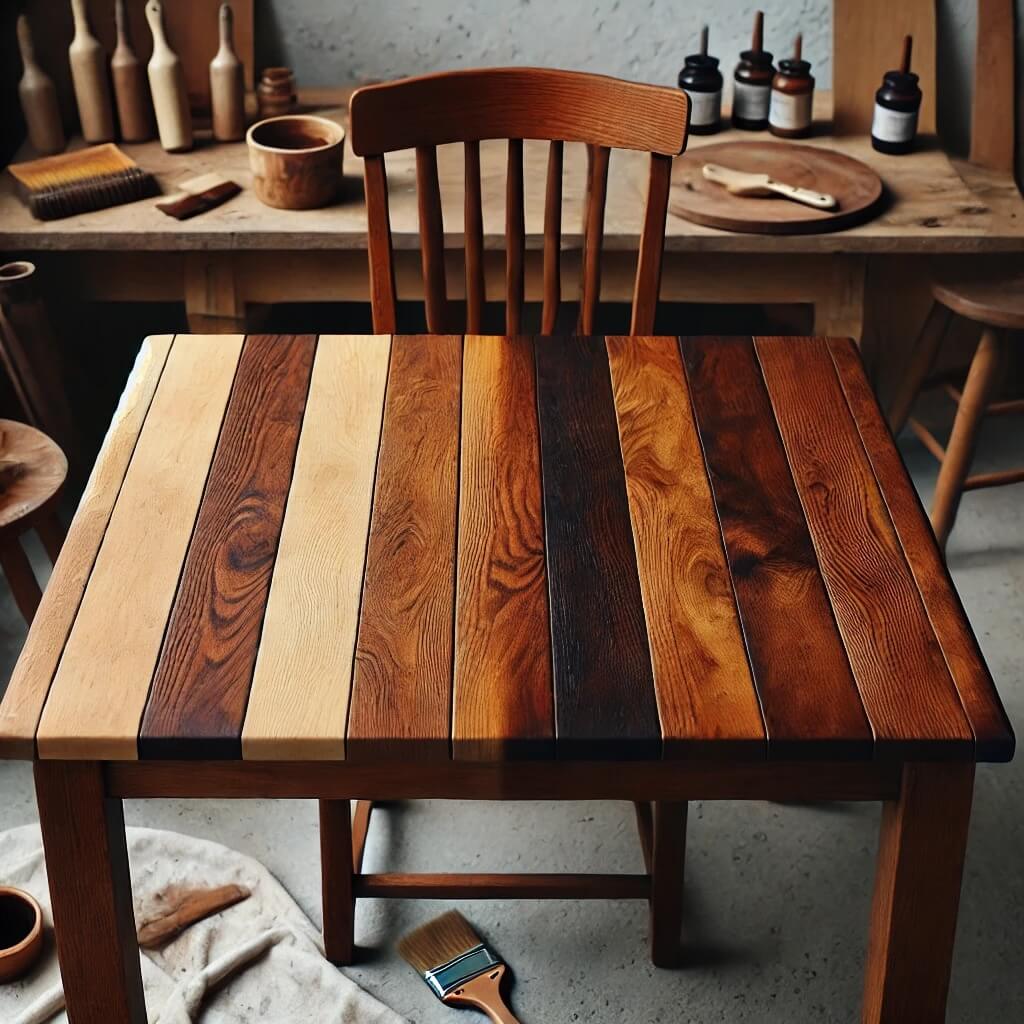
- Apply the stain. Brush, sponge, or rag-apply the strained mimosa liquid, working with the grain. Multiple thin coats build depth more evenly than one heavy coat.
- Let each coat dry fully (typically several hours depending on humidity) before assessing color and applying additional coats.
- Neutralize excess tannin (optional). A very light alum wash after the final coat can help “set” the color and reduce future bleed-through if the piece will later be top-coated with a water-based finish.
- Seal. Because the mimosa stain itself offers only modest UV and moisture protection, apply a separate protective topcoat — a hardwax oil, water-based polyurethane, or traditional oil finish — appropriate to how the furniture will be used. This is the step that actually delivers most of the long-term durability; the stain provides color and a small preservative assist, not a substitute for a finish coat.
- Cure. Allow the topcoat to cure fully per its manufacturer instructions before placing the piece back into regular use.
Where This Method Works Best — and Where It Doesn’t
Good fit:
- Interior furniture restoration where a warm, non-uniform, artisanal tone is desired
- Raw or reclaimed wood pieces being refinished from bare wood
- Projects where avoiding VOC-heavy synthetic stains is a priority (nurseries, bedrooms, small enclosed workshops)
- Decorative items, small-batch furniture makers, and restorers marketing an eco-conscious product line
Poor fit:
- Exterior furniture requiring heavy-duty weatherproofing without a robust topcoat system
- Wood species with very low natural porosity, where tannin penetration will be shallow and uneven
- Situations requiring precisely repeatable, batch-consistent color — natural tannin extracts vary by harvest, bark age, and water mineral content, so exact shade matching across large batches is harder than with synthetic stains
- Any application where the finished surface will have direct, repeated food contact without a food-safe topcoat, since the raw stain itself has not been evaluated for food-contact safety
Sustainability and Sourcing Considerations
Mimosa tenuiflora is noted as a strong source of fuel wood that works well for posts, largely due to its high tannin content protecting it from rot — meaning the tree has multiple end-of-life and byproduct uses beyond bark harvesting, which supports a lower-waste supply chain when sourced from managed stands. Because the tree resprouts vigorously after cutting and tolerates the arid Caatinga environment, responsibly managed harvesting can be relatively low-impact compared to slow-growing hardwood sources used for some synthetic-dye feedstocks.
That said, “natural” does not automatically mean “unregulated” or “risk-free.” Buyers should verify sourcing claims, avoid suppliers that cannot describe their harvesting practices, and be aware that in some countries the plant’s other alkaloid content (unrelated to the tannins used for dyeing) makes certain preparations legally controlled — the root bark used for tannin extraction and dyeing is a different application from those preparations, but it is worth knowing local regulations before ordering internationally.