Library
Tepezcohuite for Skin: The Complete, Evidence-Based Guide
Quick Answer
Tepezcohuite — the bark of Mimosa tenuiflora (also called Mimosa hostilis or jurema preta) — has real, peer-reviewed evidence behind it for one thing in particular: helping chronic wounds like venous leg ulcers close faster. A controlled clinical trial published in the Journal of Ethnopharmacology found a 92% reduction in ulcer size in patients treated with a tepezcohuite hydrogel, versus almost no improvement in the control group. What the science does not support, at least not yet in humans, is the more dramatic marketing language around “overnight regeneration,” guaranteed wrinkle reversal, or acne cures. This guide separates what’s documented from what’s still folklore, and shows how to use tepezcohuite safely if you decide to try it.
Tepezcohuite Native Habitat and Key Characteristics
Tepezcohuite is the traditional Nahuatl name — it translates roughly to “tree of the skin” — for the dried inner bark of Mimosa tenuiflora, a small, thorny tree native to the dry Caatinga scrubland of northeastern Brazil and the semi-arid regions of southern Mexico and Central America. Outside of skincare contexts, the same tree also goes by Mimosa hostilis and jurema preta, names more commonly associated with its use in dye-making, tanning, and Afro-Brazilian and Mesoamerican ethnobotanical traditions.
For skin, what matters is the bark’s chemistry. Phytochemical analyses have identified a dense mix of tannins, flavonoids, saponins, and complex polysaccharides called arabinogalactans in the cortex. These compounds are the working parts behind tepezcohuite’s reputation: tannins for astringency and antimicrobial action, flavonoids for antioxidant defense, saponins for gentle surfactant and anti-inflammatory effects, and arabinogalactans — isolated and studied specifically for wound repair — for stimulating fibroblast activity, the skin cells responsible for producing new collagen during healing.
A Brief History Worth Knowing
Indigenous communities in what is now Mexico and Brazil have used tepezcohuite bark for burns, cuts, and skin infections for centuries, typically ground into a powder and applied directly to wounds or brewed into washes. Spanish colonial-era records from the 16th century already describe its use among native populations.
The ingredient’s modern scientific rediscovery has a specific origin point: the 1985 Mexico City earthquake and a series of industrial gas explosions in Mexico during the 1980s. Burn victims were treated with tepezcohuite preparations when conventional supplies ran short, and the apparent results pushed researchers to formally investigate what folk medicine had been claiming for generations. That’s also the moment the ingredient picked up some mythology it hasn’t fully shaken — media coverage at the time reportedly overstated its properties, a pattern that taxonomic and pharmacology researchers have specifically flagged as a source of ongoing confusion in the literature.
That confusion matters for anyone researching the ingredient today. Because tepezcohuite, Mimosa hostilis, and jurema preta describe the same botanical source, articles and product listings often blend skincare claims with unrelated cultural, dye-making, or ethnobotanical content about the same tree, without distinguishing which use case a given piece of research actually supports. A study on bark tannins used for leather tanning tells you nothing about wound-healing efficacy, and a wound-healing trial tells you nothing about dye colorfastness. Reading past the shared name to the specific application is the single most useful filter for evaluating any tepezcohuite claim.
From Folk Remedy to Regulated Ingredient
Today, tepezcohuite shows up across a wide span of the skincare market — from small-batch artisanal soap makers to formulations sold by larger cosmetic brands. Regulatory treatment varies considerably by country. In Mexico, where the tradition originates, tepezcohuite has long-standing recognition as a folk remedy and appears in officially catalogued herbal medicine references. In the United States, it’s regulated the way any other plant-derived cosmetic ingredient is: it falls under FDA cosmetic rules rather than drug rules as long as products don’t make disease-treatment claims, which is exactly why credible sellers describe it as “traditionally used to support skin healing” rather than “cures wounds.” The European Union and other markets apply their own cosmetic-ingredient safety assessment frameworks, and acceptance varies by country depending on how much safety documentation a given supplier or brand has filed.
This regulatory patchwork is worth understanding because it explains why marketing language differs so much between sellers. A brand making a therapeutic claim (“heals burns”) is edging into medicinal/drug territory in most jurisdictions, which requires a different — and much higher — evidentiary and regulatory bar than a cosmetic claim (“supports the skin’s natural repair process”). When you see wildly different levels of confidence in different tepezcohuite marketing copy, this is usually why.
What the Research Actually Shows
This is where most articles about tepezcohuite get vague. Here’s the evidence broken down by how strong it actually is.
Strong evidence: chronic wound and ulcer healing
The best human data on tepezcohuite comes from a randomized, controlled trial on venous leg ulcers — a slow-healing wound type caused by poor circulation. Patients received either a hydrogel containing 5% Mimosa tenuiflora cortex extract or a plain hydrogel, applied after standard wound cleaning. After 13 weeks, the treatment group saw a mean 92% reduction in ulcer area, and every patient in that group showed measurable improvement. In the control group, only one patient improved. A separate randomized, double-blind trial from the Interdisciplinary Wound and Ostomy Care Center at Mexico City’s Hospital General “Dr. Manuel Gea González” reached similar conclusions about safety and efficacy for venous leg ulcers. A 2018 systematic review of medicinal plants used for cutaneous wound healing in humans singled out Mimosa tenuiflora as the most frequently studied plant in the prior decade, citing reports of complete lesion healing.
This is genuinely solid evidence — randomized, controlled, published in a peer-reviewed journal, and replicated across separate research teams.
Moderate evidence: cell-level wound repair mechanisms
A laboratory study isolated the arabinogalactan fraction from Mimosa tenuiflora bark and tested it directly on human dermal fibroblasts and keratinocytes. The arabinogalactans significantly stimulated fibroblast proliferation and activity — a plausible mechanism for the clinical wound-healing results above. Interestingly, the same study found that other polyphenol-rich fractions of the raw water extract were actually toxic to fibroblasts at higher concentrations, which is a useful reminder that “natural” and “more concentrated” don’t automatically mean “better” or “safer.”
Separate research has documented antimicrobial activity against organisms commonly implicated in skin infections, including Staphylococcus aureus, E. coli, and several Candida species, which lines up with the bark’s traditional use for preventing infection in open wounds.
Weak or absent evidence: anti-aging, wrinkles, and acne claims
Here’s the honest gap. As of this writing, there are no published, peer-reviewed clinical trials testing Mimosa tenuiflora extract specifically for wrinkle reduction, skin firming, or photoaging in otherwise healthy adults. The anti-aging case for tepezcohuite is built almost entirely by inference: it contains antioxidant flavonoids and tannins, antioxidants are broadly useful against the free-radical damage involved in photoaging, and the wound-healing data shows the extract can support tissue repair — therefore, the reasoning goes, it should help aging skin too. That chain of logic is plausible, but it is not the same thing as a clinical trial showing measurably fewer wrinkles after a defined period of use.
The same caution applies to acne. Tepezcohuite’s anti-inflammatory and antimicrobial properties are reasonable grounds for it to help calm irritated, breakout-prone skin as part of a broader routine, but there isn’t a rigorous clinical trial establishing it as an acne treatment on its own.
It’s also worth noting a formulation detail that gets lost in most consumer marketing: the concentration used in the successful ulcer trials (5% cortex extract in a purpose-built hydrogel) is typically far higher, and far more controlled, than what shows up in a mass-market “tepezcohuite anti-aging serum.” A product claiming to contain the ingredient isn’t the same as a product delivering it at a clinically tested dose and vehicle.
Documented Skin Benefits, Ranked by Evidence Strength
| Benefit | Evidence level | What’s actually documented |
|---|---|---|
| Chronic wound / venous ulcer healing | Strong (RCTs) | Up to 92% reduction in ulcer area over 13 weeks in controlled trials |
| Fibroblast stimulation / tissue repair mechanism | Moderate (in vitro) | Arabinogalactan fraction significantly increases fibroblast proliferation |
| Antimicrobial action on skin pathogens | Moderate (in vitro) | Documented activity against S. aureus, E. coli, Candida spp. |
| Anti-inflammatory / soothing effect | Moderate (traditional + preclinical) | Reduced inflammatory markers in lab models; consistent with traditional burn-care use |
| Antioxidant activity | Moderate (in vitro) | High tannin/flavonoid antioxidant capacity in comparative extract testing |
| Hydration / barrier support | Limited | Plausible from polysaccharide content; not clinically isolated as a standalone outcome |
| Wrinkle reduction / anti-aging | Weak | No published human trials specific to this outcome |
| Acne treatment | Weak | Anecdotal and mechanism-based only; no dedicated clinical trials |
| Scar fading | Weak/anecdotal | Plausible from faster, less-inflamed healing; not independently measured in trials |
How Tepezcohuite Is Actually Used
Common formats
- Raw bark powder — the traditional form, mixed into water, aloe vera gel, or a carrier oil for direct application or DIY masks.
- Hydrogels and clinical-grade creams — the vehicle used in the wound-healing trials; these keep the extract in sustained contact with damaged skin.
- Serums and after-sun/soothing products — lighter formulations aimed at redness, irritation, and general skin comfort rather than deep wound care.
- Soap and cleansing bars — a popular artisanal application, prized more for gentle cleansing than for therapeutic dosing.
Commercial formulations typically use tepezcohuite at concentrations between roughly 1% and 10%, depending on the product category; the clinical ulcer trials used a 5% cortex extract in hydrogel.
Matching the format to the goal
Not every tepezcohuite product is built for the same job, and matching the format to your actual goal makes a real difference:
- For minor cuts, scrapes, or irritated patches of skin, a stabilized cream or hydrogel formulation is closer to what was clinically tested than loose powder, since the vehicle keeps the extract in sustained contact with the skin and helps control the effective dose.
- For general skin soothing, hydration, or an at-home spa-style treatment, a DIY mask with raw bark powder is a reasonable, low-stakes way to experiment, since the goal is comfort and texture rather than measurable wound closure.
- For daily use as part of an antioxidant-focused routine, a lightweight serum or lotion with a labeled tepezcohuite/Mimosa tenuiflora extract concentration is easier to use consistently than powder, and easier to layer under sunscreen and moisturizer.
- For cleansing, cold-process soap bars containing the bark are popular in artisanal skincare circles, though contact time during washing is far shorter than a leave-on product, so treat any therapeutic claims for soap formats with extra skepticism.
Pairing tepezcohuite with other actives
Because tepezcohuite’s evidence base is strongest for soothing and repair rather than active exfoliation or cell turnover, it tends to pair well — rather than compete — with ingredients that do the opposite job. Some formulators layer it underneath a retinol product to help offset the dryness and irritation that retinoids can cause, or combine it with vitamin C for a broader antioxidant effect. If you’re combining actives yourself, introduce them one at a time, a few days apart, so you can tell which ingredient is responsible if your skin reacts.
A simple, low-risk way to try it
- Mix roughly one teaspoon of finely milled bark powder with a soothing base such as aloe vera gel or a few drops of a fragrance-free carrier oil until you have a smooth paste.
- Patch test on the inner forearm and wait 24–48 hours before using it anywhere else.
- If there’s no reaction, apply to clean, dry skin and leave on for 15–20 minutes before rinsing with cool water.
- Follow with a plain moisturizer and, during the day, sunscreen — tepezcohuite is not a UV filter and does not replace one.
For anything beyond minor, superficial skin concerns — a real burn, a non-healing wound, a deep or infected lesion — this is a “see a clinician” situation, not a DIY one. The clinical data that actually supports tepezcohuite involved medical supervision, controlled extract concentrations, and standardized wound care alongside it.
Safety, Side Effects, and Who Should Be Cautious
Topical tepezcohuite is generally well tolerated, and the trials above didn’t report serious adverse events. That said:
- Allergic contact dermatitis is possible, particularly in people sensitive to other plants in the Fabaceae (legume) family. Always patch test before broader use.
- Pregnancy and breastfeeding: topical use is generally considered lower-risk than internal use, but safety data is limited either way — check with a healthcare provider first, and avoid oral consumption of the bark entirely during pregnancy.
- Anticoagulant medications: tannins can theoretically influence clotting; people on blood thinners or with bleeding disorders should get medical advice before regular use.
- Large or open wounds: don’t self-treat significant burns or deep wounds with raw powder. The trials that showed real benefit used sterile, standardized extracts under clinical supervision — not unregulated bark powder applied at home.
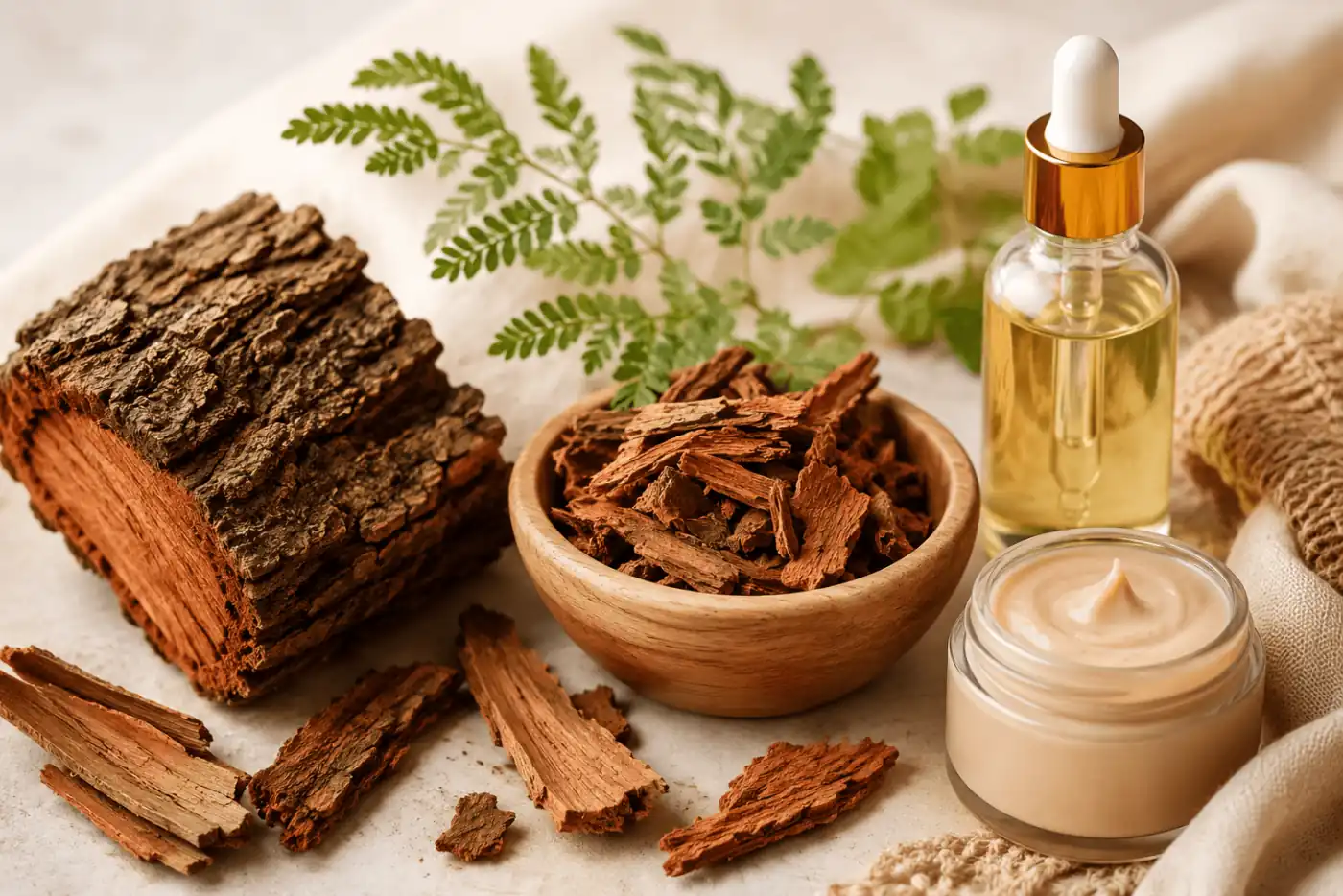
- Sourcing quality: adulteration is a documented problem in the tepezcohuite/MHRB trade. Authentic bark has a specific reddish-brown color and fibrous texture; buy from suppliers who can speak to sourcing, harvest region, and testing.
Tepezcohuite vs. Other Skincare Actives
| Ingredient | Primary mechanism | Best-supported use | Human clinical evidence |
|---|---|---|---|
| Tepezcohuite | Antioxidant, antimicrobial, fibroblast stimulation | Chronic wound/ulcer healing | Strong for wound healing; weak for anti-aging |
| Retinol | Cell turnover acceleration | Wrinkles, texture, acne | Strong, extensive |
| Vitamin C | Antioxidant, collagen cofactor | Brightening, photoaging | Strong |
| Niacinamide | Barrier support, sebum regulation | Redness, barrier repair | Strong |
| Aloe vera | Hydration, mild anti-inflammatory | Minor burns, soothing | Moderate |
| Calendula | Anti-inflammatory, gentle wound support | Sensitive/irritated skin | Moderate |
| Centella asiatica (Cica) | Collagen synthesis, barrier repair | Scarring, barrier recovery | Moderate to strong |
Tepezcohuite’s real differentiator isn’t that it beats these ingredients across the board — it’s the unusually strong, randomized clinical data behind its wound-healing use, which is more rigorous than the evidence base for most “natural” skincare actives, even as its anti-aging reputation runs ahead of the science.
Quality, Sourcing, and Spotting a Bad Product
Because tepezcohuite sits at the intersection of folk remedy, artisanal craft, and mainstream cosmetics, quality control varies enormously between sellers — arguably more than it does for most standardized skincare actives.
What affects quality:
- Harvest method. Bark taken from wild trees using sustainable, rotational harvesting practices tends to preserve tree health and long-term supply; aggressive stripping does not. Reputable suppliers can describe how and where their bark is harvested.
- Processing and drying. Improperly dried or stored bark is more prone to microbial contamination and degradation of the active tannins and flavonoids that make the ingredient useful in the first place.
- Adulteration. Because tepezcohuite is prized and not always cheap to source authentically, some suppliers have been known to cut it with other, visually similar plant material. Authentic bark has a distinctive reddish-brown color, a fibrous texture, and a recognizable astringent scent; lab-based chemical fingerprinting is the only fully reliable way to confirm authenticity, but consistent color and texture from a trusted, repeat supplier is a reasonable practical proxy.
- Storage. Properly stored bark, kept cool, dry, and away from direct light, is generally considered to retain potency for a couple of years; heat and humidity accelerate degradation.
What to look for in a supplier or finished product:
- Clear sourcing information (harvest region, wild-crafted vs. cultivated).
- Willingness to describe testing practices, even informally, rather than vague “certified organic, ancient secret” language with no specifics.
- Ingredient lists that name the extract concentration or vehicle (hydrogel, cream base, etc.) rather than just listing “tepezcohuite” with no further detail.
- Pricing in a plausible range for genuine harvested bark — prices dramatically below the market average are a common red flag for adulterated or mislabeled material.
Common Misconceptions Worth Correcting
A few claims circulate persistently enough in tepezcohuite marketing that they’re worth addressing directly.
“It regenerates skin cells overnight.” Cellular turnover and collagen synthesis are gradual biological processes that unfold over weeks, not hours. Even the strongest clinical results for tepezcohuite — the venous ulcer trials — measured improvement over 8 to 13 weeks of consistent, supervised treatment, not overnight.
“It’s a proven anti-aging miracle.” As covered above, there’s currently no published human trial testing tepezcohuite specifically for wrinkles or photoaging. The antioxidant argument is reasonable; the “proven” framing isn’t supported by the current literature.
“More concentrated is always better.” The in vitro fibroblast research actually found the opposite for some fractions of the extract — certain polyphenol-rich components were toxic to fibroblasts at higher concentrations, while the isolated arabinogalactan fraction stimulated healthy cell activity. This is a useful general reminder for botanical actives: efficacy and dose don’t scale in a straight line, and “natural” doesn’t mean “no ceiling on concentration.”
“All tepezcohuite products are interchangeable.” A 5% standardized cortex extract in a purpose-built hydrogel, tested in a randomized clinical trial, is a different product from raw bark powder mixed at home into an aloe gel. Both may be legitimately called “tepezcohuite,” but they are not equally validated for the same use case.
Where the Research Still Needs to Go
The clinical evidence for tepezcohuite is unusually strong for a traditional botanical, but it’s also narrow. A few gaps stand out for anyone tracking the science going forward:
- Larger, more diverse human trials. The strongest trials to date involved relatively small patient cohorts focused specifically on venous leg ulcers. Broader dermatological trials — across different skin types, age ranges, and conditions — would help clarify how far the wound-healing findings generalize.
- Dedicated anti-aging and acne trials. Given how often these claims appear in marketing, a randomized trial testing tepezcohuite specifically against photoaging or inflammatory acne, with objective endpoints, would settle a debate that’s currently running well ahead of the evidence.
- Standardized extraction and dosing. Different studies and different commercial products use different extraction methods (aqueous vs. ethanolic) and different concentrations, which makes it hard to compare results or to know what “an effective dose” actually looks like outside a clinical hydrogel formulation.
- Long-term safety data. Traditional use over centuries is meaningful evidence of general tolerability, but it isn’t the same as formal, long-duration toxicology and safety studies at the concentrations used in modern cosmetic products.
Frequently Asked Questions
The Bottom Line
Tepezcohuite is one of the rare “traditional” skincare botanicals with genuine randomized clinical trial support — but that support is specific, not universal. It has strong evidence for helping chronic wounds like venous leg ulcers heal, decent mechanistic and antimicrobial data to back up traditional burn-care use, and a much thinner evidence base for the anti-aging and acne claims that dominate a lot of product marketing. If you’re drawn to it for soothing, barrier-supportive, or minor-wound-care use, the traditional and clinical record gives you real reason to try it, with a patch test and reasonable expectations. If you’re hoping it will noticeably erase wrinkles or clear acne on its own, the current science just isn’t there yet — pair it with ingredients that do have that evidence, like retinol or vitamin C, rather than relying on tepezcohuite alone.
Sources
- Rivera-Arce, E., Chávez-Soto, M.A., Herrera-Arellano, A., et al. “Therapeutic effectiveness of a Mimosa tenuiflora cortex extract in venous leg ulceration treatment.” Journal of Ethnopharmacology, 2007;109(3):523–528.
- “Mimosa tenuiflora.” Wikipedia.
- “Arabinogalactans from Mimosa tenuiflora (Willd.) Poiret bark as active principles for wound-healing properties.” ScienceDirect / Journal of Ethnopharmacology.
- Camargo-Ricalde, S.L. “Descripción, distribución, anatomía, composición química y usos de Mimosa tenuiflora (Fabaceae-Mimosoideae) en México.” ResearchGate.
- UTEP Herbal Safety, “Tepezcohuite” fact sheet.
- Contreras-Ruiz, J. et al. “A randomised comparative trial on the use of a hydrogel with tepescohuite extract (Mimosa tenuiflora cortex extract-2G) in the treatment of venous leg ulcers.” PMC.
- “Therapeutic Effects of Medicinal Plants on Cutaneous Wound Healing in Humans: A Systematic Review.” PMC.
- Healthline. “Does Tepezcohuite Have Medicinal Properties?”
- North Biomedical. “Tepezcohuite for Skin: What the Mexican ‘Skin Tree’ Actually Does (And Doesn’t) for Aging Skin.”
This article is for informational purposes only and does not constitute medical advice. Consult a dermatologist or physician for diagnosis and treatment of any skin condition, and before using botanical extracts on broken skin, during pregnancy, or alongside medications.