
Library
Jurema’s Tannin Profile vs. Oak Gall and Walnut Dyes: A Natural Dyer’s Chemistry Comparison
Quick Answer
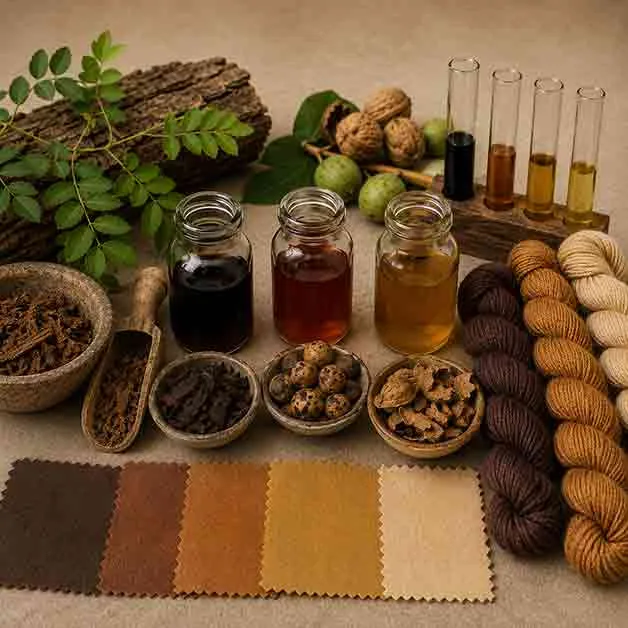
Jurema (Mimosa tenuiflora, also called Jurema Preta or Mimosa Hostilis Root Bark) contains roughly 16% condensed tannins, dominated by proanthocyanidins that produce purples, magentas, and reddish-browns without requiring a metal mordant. Oak gall contains hydrolyzable tannins (mostly gallotannins), which are colorless to pale beige on their own and are prized as a mordanting agent rather than a standalone color source. Walnut hull and bark combine tannins with juglone, a naphthoquinone pigment that produces substantive, mordant-free brown dye. Each source belongs to a different tannin chemical family, and that family determines the color, the fastness, and how the dye behaves on fiber.
Why Tannin Chemistry Determines the Dye You Get
Natural dyers often treat “tannin” as a single ingredient, but tannins split into two structurally distinct groups, and the difference explains almost everything about how Jurema, oak gall, and walnut behave in a dye pot. Hydrolyzable tannins, found in oak galls, are built from a sugar core esterified with gallic acid units; they break down into gallic acid and related compounds when hydrolyzed, and on their own they contribute little visible color. Condensed tannins, found in Jurema bark, are polymers of flavan-3-ol units known as proanthocyanidins, and they resist hydrolysis while carrying inherent pigment. Walnut occupies a middle ground: it delivers tannins alongside a separate pigment class, naphthoquinones, that behave more like a direct dye than a mordant.
This distinction is not academic trivia. It decides whether a dyer needs a separate mordanting step, what color family results, how the dye reacts with iron, and how the color holds up over years of light exposure. A comparison across these three sources gives a practical framework for choosing the right tannin for a specific project.
What Is Jurema’s Tannin Profile?
Jurema Preta, botanically Mimosa tenuiflora (synonym Mimosa hostilis), is a small tree native to the Caatinga region of northeastern Brazil and parts of Mexico and Central America. The root bark is the part most valued by natural dyers and leatherworkers.
Tannin Type: Condensed Tannins (Proanthocyanidins)
Pharmacognostical analysis of genuine Jurema bark found that tannins are the dominant chemical component, making up about 16% of the dried bark, and that this tannin fraction consists primarily of proanthocyanidins rather than gallotannins or ellagitannins. Later phytochemical work identified the specific proanthocyanidin subtypes in Jurema bark as procyanidins and prodelphinidins, the same polymer family found in condensed-tannin sources like acacia (mimosa bark) and quebracho.
Because condensed tannins are large, resistant to breakdown, and inherently colored, Jurema bark does not need a separate mordanting agent to bind to fiber. This is a meaningful practical difference from oak gall, which is nearly colorless until paired with a metal salt.
Color Range and Behavior on Fiber
Natural-dye suppliers and practitioner guides consistently describe Jurema’s dye output as a spectrum running from reddish-brown through burgundy, magenta, and violet to deep purple, depending on the mordant, the fiber, and the pH of the dye bath. Because the color-bearing proanthocyanidins are also the tannins, Jurema functions as what dyers call a “substantive” or self-mordanting dye on protein fibers such as wool and silk, though cellulose fibers like cotton and linen still benefit from an alum mordant for depth and fastness.
The color is also pH-reactive: acidic dye baths shift the result toward red, neutral baths produce the classic pink-to-purple range, and alkaline conditions push the color toward brown. This pH sensitivity is a direct consequence of the anthocyanidin-related chemistry in the proanthocyanidin polymer, which changes its conjugation and color as protonation state changes.
Traditional and Modern Uses
Beyond textile dyeing, Jurema bark’s tannin concentration has made it a traditional material for tanning animal hides in northeastern Brazil, where the tannins bind to collagen fibers in a process functionally similar to vegetable-tanned leather production elsewhere in the world. The bark has also been studied as a tannin-based raw material for wood adhesives, since condensed tannins react with formaldehyde in a manner comparable to phenol, giving Jurema industrial relevance well outside the dye studio.
What Is Oak Gall’s Tannin Profile?
Oak galls, sometimes called oak apples or gallnuts, are abnormal growths that form on oak twigs and leaves in response to wasp larvae. The Aleppo oak (Quercus infectoria) produces the galls most prized historically for dyeing and ink-making, though other oak species yield galls with varying tannin concentrations.
Tannin Type: Hydrolyzable Tannins (Gallotannins)
Oak galls are composed of roughly 50 to 70 percent hydrolyzable tannins by weight, chiefly gallotannins, which structurally consist of a central glucose molecule esterified with multiple gallic acid units through ester and meta-depside bonds. Analysis of Aleppo gall tannin structures has identified galloyl-substituted glucose cores carrying up to ten or more galloyl groups, which is part of why gallotannin, also called tannic acid, is considered the archetypal hydrolyzable tannin.
Unlike Jurema’s condensed tannins, hydrolyzable tannins break down into their component gallic acid and glucose when exposed to acid, base, or enzymatic hydrolysis. This chemical instability is actually functionally useful in textile work: it is part of why gallotannin reacts so readily and predictably with metal ions, especially iron.
Color Range and Behavior on Fiber
On its own, oak gall tannin produces only a light beige to tan stain on cellulose fiber, which is precisely why dyers use it as a mordant rather than a standalone dye. Its primary role in a natural dye workflow is preparing cellulose fibers such as cotton, linen, and hemp to accept and retain dye more effectively, without leaving the strong background color that other tannins like sumac or walnut would impart. Comparative testing among white oak, scarlet oak, and Aleppo oak galls found that Aleppo galls produced noticeably deeper color development than the North American oak species when paired with iron or overdyed with plant dyes like weld and madder, reflecting their higher tannin concentration.
When combined with iron salts, oak gall tannin produces the classic gray-to-black range associated with historic iron gall ink, a technology described as far back as Pliny the Elder’s Naturalis Historia in the first century CE. This iron-gallotannin reaction, forming a blue-black iron complex, is the chemical foundation of European ink-making for roughly two thousand years and remains a favored technique for grays and blacks in modern natural dyeing.
Aging and Stability
A mass spectrometry study comparing tannins from oak gallnuts, walnut, and catechu after artificial aging found that oak gallnut tannins showed comparatively little degradation over time, while walnut and catechu tannins showed a significant increase in hydroxybenzoic acid content as they broke down. This suggests oak gall dyes and inks, once fixed to fiber, are relatively stable compared to some other tannin sources, which is consistent with the survival of centuries-old iron gall manuscripts.
What Is Walnut’s Tannin and Pigment Profile?
Walnut dye comes from the green hulls, husks, bark, or leaves of Juglans regia (English or Persian walnut) and Juglans nigra (black walnut). Unlike Jurema and oak gall, walnut’s color does not come from tannins alone.
Tannin Type: Tannins Plus a Naphthoquinone Pigment
Walnut hulls and bark contain a mixed profile of tannins, including ellagitannins, along with gallic acid, caffeic acid, flavonoids like quercitrin, and critically, juglone (5-hydroxy-1,4-naphthoquinone). Juglone is a distinct pigment class from both condensed and hydrolyzable tannins; it is chemically related to lawsone, the coloring compound in henna, and both belong to the naphthoquinone family. In fresh green walnut hulls, juglone occurs at concentrations reported around 2 to 4 percent of fresh weight, making the hull a notably concentrated pigment source even before the tannin fraction is counted.
Color Range and Behavior on Fiber
Juglone gives walnut dye its dark reddish-brown to near-black color, which is why walnut is classified in the Colour Index as Natural Brown 7. Because juglone itself acts as a substantive dye, walnut hull dye typically requires no mordant to bind color to wool, cotton, silk, or hair, a property natural dye suppliers highlight as one of walnut’s main practical advantages over tannin sources like oak gall that need a metal assist. Walnut dyes are also noted for excellent lightfastness, a property attributable to the stability of the naphthoquinone-tannin complex once bound to fiber.
Studies on wool dyed with walnut extract and various metal mordants, including aluminum sulfate, ferrous sulfate, and stannous chloride, show that while walnut does not require a mordant, adding one shifts the shade and improves certain fastness properties, giving dyers a way to fine-tune results within the brown-to-black range.
Aging and Stability
The same mass spectrometry comparison referenced above found that walnut tannins, unlike oak gallnut tannins, showed a significant increase in hydroxybenzoic acid content after artificial aging, indicating a different, and in some respects less chemically stable, degradation pathway. This does not mean walnut dyes fade badly in practice, since juglone’s own substantivity and reported lightfastness offset this at the pigment level, but it does mean the tannin and pigment components age through different chemical routes than Jurema’s condensed tannins or oak gall’s gallotannins.
How Each Tannin Reacts With Iron
Iron modification is one of the most common techniques in natural dyeing, and it highlights just how differently these three tannin families behave once a metal ion enters the bath.
Oak gall’s hydrolyzable gallotannins are the textbook case. Gallic acid units on the gallotannin structure coordinate readily with ferrous or ferric ions, forming iron-gallate complexes that shift from clear to deep blue-black almost immediately, the same reaction documented in the historic iron gall ink tradition. This reaction is fast, dramatic, and reliable, which is why oak gall paired with iron remains the standard route to true blacks and cool grays in natural dyeing.
Walnut’s response to iron is more incremental. Because juglone already carries strong, dark color on its own, adding iron mostly deepens and cools an already-brown result rather than triggering the dramatic color shift seen with oak gall. Dyers working with walnut and iron are typically pushing an existing brown further toward black, not creating color from nothing.
Jurema’s condensed tannins respond to iron differently again. Because proanthocyanidins are large, resistant polymers rather than small hydrolyzable units, their iron complexes tend to shift the existing purple-to-red range toward cooler, muddier, more grayed tones rather than producing the crisp black associated with gallotannins. This is consistent with supplier and practitioner guidance describing gallotannin-type tannins as the preferred choice specifically when a clean gray or black is the goal, with condensed tannins like Jurema reserved for warmer, saturated color families.
Understanding this iron behavior matters practically: a dyer who wants black should generally start with oak gall, not Jurema or walnut, while a dyer chasing the purple-magenta range native to Jurema should treat iron as a tone-muting finishing step rather than a primary color-development tool.
Historical Context: Three Very Different Traditions
The three tannin sources also carry distinct historical trajectories, which is useful context for understanding why each is used the way it is today.
Oak gall has the longest documented Western history among the three. Its use in iron gall ink dates back at least to antiquity, referenced in Pliny the Elder’s first-century Naturalis Historia, and it became the dominant writing ink across Europe and the Islamic world for roughly two thousand years, used for everything from medieval manuscripts to the signatures on founding political documents. Its parallel role in leather tanning and as a textile mordanting agent developed alongside this ink tradition, particularly through Aleppo oak galls imported along historic trade routes.
Walnut’s dye history runs through both European and Asian textile traditions, where walnut hulls, shells, and leaves were used to dye wool, cotton, and hair, prized for producing rich browns without requiring imported or manufactured mordants. Walnut hull dyeing also holds a long place in folk hair-coloring practice, a use that persists today given juglone’s classification as Natural Brown 7 in cosmetic and textile contexts.
Jurema’s history is rooted in the Caatinga biome of northeastern Brazil, where indigenous communities have used the root bark for centuries in textile dyeing, hide tanning, and topical wound care. Its dye and tanning applications developed within these regional traditions rather than through the long-distance trade networks that shaped oak gall’s spread, and its ethnobotanical profile, including alkaloid content unrelated to its tannins, has made it a subject of renewed scientific interest well beyond textile chemistry.
Practical Dye-Bath Notes for Each Source
A few working notes are worth keeping in mind for anyone testing these three tannins side by side.
For Jurema, simmering the root bark or powder extracts color efficiently, and pH adjustment is the main lever for controlling the final hue. A more acidic bath, achieved with a small amount of citric acid or vinegar, pushes the result toward red, while a pinch of soda ash pushes it toward brown, with neutral conditions landing in the pink-to-purple middle range.
For oak gall, the standard approach uses it as a pre-mordant at roughly 10 to 15 percent of the weight of fiber, followed by a separate alum bath, before the fiber is overdyed with a color-bearing plant dye. Because oak gall itself stains cellulose only a light beige, dyers should not expect strong standalone color and should plan it as a preparatory step rather than a finishing one.
For walnut, no mordant is required for a usable brown, but adding a metal salt such as alum, iron, or tin allows fine control over the final shade, from warm tan through chocolate to near-black, which is useful when a project calls for a specific point along that range rather than whatever shade the unmordanted hull produces.
Side-by-Side Comparison
| Feature | Jurema (Mimosa Hostilis) | Oak Gall | Walnut |
|---|---|---|---|
| Tannin class | Condensed tannins (proanthocyanidins) | Hydrolyzable tannins (gallotannins) | Tannins plus juglone (naphthoquinone) |
| Approximate tannin content | ~16% of dried root bark | ~50–70% of gall weight | Variable; juglone alone ~2–4% in fresh green hull |
| Color without mordant | Reddish-brown to magenta/purple | Pale beige only | Reddish-brown to near-black |
| Needs a metal mordant for color? | No (self-mordanting on protein fiber) | Yes, functions primarily as the mordant | No (substantive dye) |
| Reaction with iron | Shifts tone darker/cooler | Produces classic gray-to-black, the base of iron gall ink | Deepens brown, moves toward black |
| Typical dyer’s role | Standalone color dye | Pre-mordant / tannin base for other dyes | Standalone color dye |
| Historical primary use | Textile dyeing, leather tanning | Ink-making, leather tanning, textile mordanting | Textile and hair dyeing, ink-making |
| Aging behavior (per mass-spec aging study) | Not directly tested in the cited study; condensed tannins generally resist hydrolysis | Little degradation after artificial aging | Notable increase in breakdown compounds after aging |
How to Choose Between Jurema, Oak Gall, and Walnut
Choose Jurema when the project calls for purples, magentas, or deep reddish-browns and you want a dye that performs without a separate mordanting stage, especially on protein fibers like wool and silk. It is also the strongest option among the three for leather tanning applications rooted in traditional practice.
Choose oak gall when the goal is preparing cellulose fiber (cotton, linen, hemp) to accept other dyes, or when the target color is gray to black through an iron reaction, as in traditional iron gall ink. Oak gall is the right tool when you specifically do not want the tannin source itself to contribute a strong background color.
Choose walnut when the project needs deep, substantive browns to near-black without a mordant step, particularly for wool, cotton, silk, or hair, and when excellent lightfastness matters more than color range flexibility.
Frequently Asked Questions
Key Takeaways
Jurema, oak gall, and walnut all fall under the broad label of “tannin dyes,” but they represent three distinct branches of tannin chemistry. Jurema’s condensed proanthocyanidins deliver self-mordanting purples and magentas. Oak gall’s hydrolyzable gallotannins deliver almost no color alone but excel as a mordant and as the chemical basis of iron gall ink. Walnut pairs tannins with juglone, a naphthoquinone that behaves as a substantive brown-to-black dye in its own right. Understanding which tannin family a dye source belongs to is the fastest way to predict its color, its mordant requirements, and its long-term stability on fiber.