
Library
Tie-Dye and Shibori Techniques Using Mimosa Hostilis Natural Dye
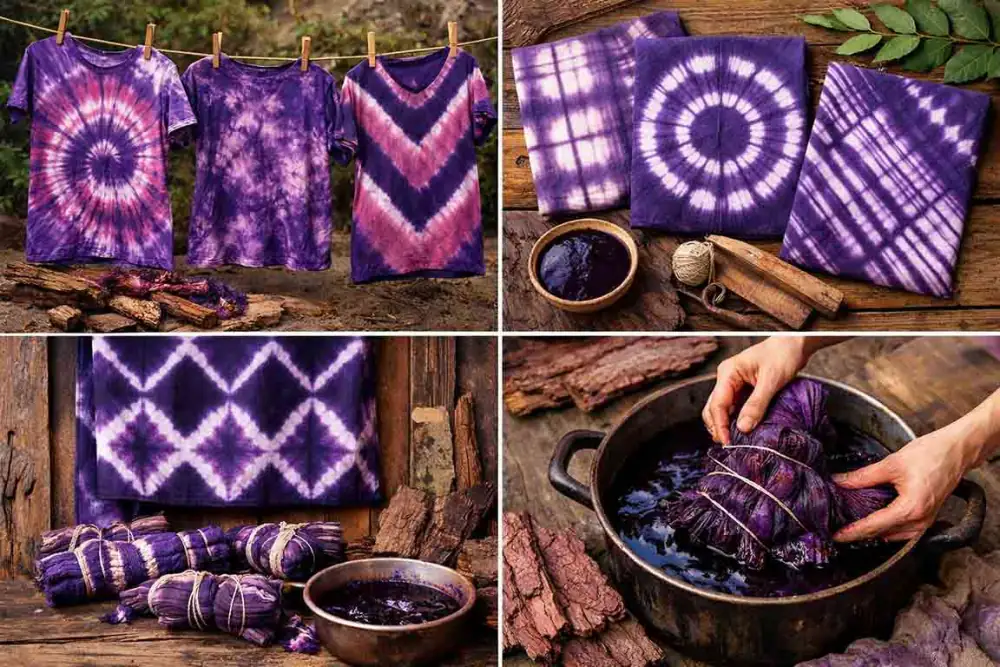
A pot of simmering root bark turns a deep wine-red within minutes, long before the fabric ever touches it. That color shift is a chemistry lesson happening in real time — and it’s the reason Mimosa Hostilis has become one of the more interesting botanical dyes for tie-dye and Shibori work. Unlike indigo, which needs a fermentation vat and an oxygen-sensitive reduction process, or madder, which requires careful temperature control to avoid dulling its reds, Mimosa Hostilis dye behaves more like a strong tea: steep it, strain it, and it’s ready to work with.
Mimosa Hostilis natural dye is a tannin-rich extract of Mimosa tenuiflora root bark that colors natural fibers in shades from plum and aubergine to rust and chestnut brown, with the final hue shaped by fiber type, mordant choice, and the pH of the dye bath. Combined with resist techniques like tie-dye and Japanese Shibori, it produces textiles where color pools, streaks, and fades in patterns no synthetic dye replicates in quite the same way.
Why the Color Comes From Tannins, Not Pigments
Most people assume “natural dye” means a plant pigment — something structurally similar to the chlorophyll in leaves or the carotenoids in carrots. Mimosa Hostilis works differently. Researchers who have extracted and characterized the bark’s tannin fraction for use in wood adhesives found it contains a high concentration of condensed tannins, the same broad chemical family used industrially for tanning and preservation. A separate phytochemical analysis of the root bark identified eight distinct type-B proanthocyanidins alongside a glycosylated flavonol and a dihydrochalcone derivative — a chemical fingerprint that explains why the dye bath shifts from red-brown toward violet as concentration increases, since proanthocyanidins oligomerize and darken as they oxidize in solution.
This matters practically because condensed tannins don’t just color fiber — they bond to it. Tannin-based dyestuffs form hydrogen bonds and, with the help of a mordant, coordinate bonds directly with the protein or cellulose structure of fabric, which is part of why tannin dyes have historically been prized for durability. A 2019 mass spectrometry study of centuries-old wool dyed with tannins from oak gall, walnut, and catechu confirmed that tannin dyes degrade slowly and predictably over time, which is precisely the kind of aging behavior conservators rely on to authenticate historic textiles. In plain terms: the same chemistry that makes Mimosa Hostilis dye rich and complex also makes it reasonably colorfast when the fabric is properly prepared.
Tie-Dye and Shibori Are Not the Same Craft Wearing Different Names
It’s tempting to treat “tie-dye” and “Shibori” as interchangeable, but they come from different lineages and different intentions. Tie-dye, as practiced in the West since the 1960s, is largely improvisational — twist, band, dunk, and see what happens. Shibori is older and more codified. The earliest surviving Shibori-dyed cloth was donated to the Tōdai-ji temple in Nara in 756 CE, part of a set of goods offered by Emperor Shōmu, and shows bound, waxed, and folded-and-clamped resists already in use. Traditional Japanese classification splits the craft into three families: tied and bound resists (kōkechi), wax resists (rōkechi), and clamped resists (kyōkechi) — a taxonomy that predates the word “Shibori” being applied to the fabric itself.
Resist-dyeing by manipulation isn’t unique to Japan, either. India’s bandhani tradition, which uses tiny thread-gathered knots, is documented in Sanskrit literature and visible in the Ajanta cave paintings from around the 6th century CE, likely predating the Japanese practice by several centuries. West Africa’s adire tradition achieves similar resist effects using cassava paste rather than binding. What ties these traditions together isn’t geography — it’s the same physical principle Mimosa Hostilis dye exploits: wherever fabric is compressed tightly enough, dye molecules can’t penetrate, and the untouched fiber stays its original color while everything around it darkens.
Building a Dye Bath That Actually Performs
The extraction step is where most of the final color potential gets decided, and it rewards patience over heat. Simmering root bark gently — rather than boiling it hard — pulls tannins into solution steadily; aggressive heat can degrade some of the more delicate proanthocyanidin structures before they’ve fully dissolved, flattening what would otherwise be a layered, wine-dark liquid into something duller. A second or third simmer using the same spent bark typically continues to release usable pigment, since the extraction is diffusion-limited rather than a one-shot event — the interior of each bark fragment holds tannin that a single 60-minute simmer doesn’t fully reach.
Once strained, the liquid’s pH becomes a genuine design variable rather than an afterthought. Tannin-derived colorants are known to shift measurably with acidity: a related study optimizing bark-tannin dyeing on hemp fabric found the ideal dyeing conditions clustered around a mildly acidic pH near 4.2, with temperature and dye time interacting to change both depth and stability of the resulting color. A splash of vinegar nudges Mimosa Hostilis dye toward warmer rust tones; a pinch of soda ash pushes it toward cooler plum and violet. Neither adjustment is dramatic on its own, but stacked across a multi-dip Shibori piece, small pH shifts compound into visible tonal gradients.
Fiber Prep Decides More Than the Recipe Does
Two identical dye baths can produce wildly different results depending on what happens to the fabric beforehand, and this is the step impatient beginners skip. Scouring — a hot wash with mild detergent or soda ash — strips away the manufacturing sizing, oils, and finishing agents that synthetic-fiber production leaves behind, all of which block dye from reaching the fiber surface. Skipping it is the single most common cause of blotchy, pale results.
Mordanting comes next, and it’s where the real chemistry of “fixing” a dye happens. Alum — potassium aluminum sulfate — has been used as a textile mordant across North America, England, China, Libya, Russia, and Turkey for centuries because the aluminum ion forms a coordination complex that bridges the dye molecule and the fiber, essentially building a chemical bridge where none existed before. Tannins can play a mordant-like role themselves, which is part of what makes Mimosa Hostilis somewhat forgiving compared to dyes that need a separate tannin pre-treatment step before a metal mordant will grab hold. Researchers exploring tannin-only, metal-free mordanting systems — using tannin-rich barks as bio-mordants in place of alum entirely — have found cotton can pick up strong color and reasonable fastness even without a metallic mordant added at all. That’s worth knowing if you’re trying to keep a dye project entirely plant-based.
Cellulose fibers (cotton, linen, hemp) and protein fibers (silk, wool) don’t take the mordant or the dye identically. Protein fibers have more reactive amine and carboxyl groups available for the tannin-mordant complex to grab onto, which is part of why silk dyed in the same Mimosa Hostilis bath as cotton typically comes out several shades deeper and leans more toward true burgundy, while cotton settles into softer plum or clay tones.
Five Techniques, Five Different Relationships With the Resist
The spiral is the technique most people picture when they hear “tie-dye.” Pinch the fabric’s center and twist until the whole piece coils into a flat disc, then band it into wedges before dyeing. Because the twist compresses fiber unevenly — tighter near the center, looser toward the edges — the color gradient it produces is naturally uneven in a way that reads as organic rather than mechanical.
Crumple dyeing skips structure almost entirely. Loosely bunch the fabric and secure it at a few random points; the dye finds its way into the folds unevenly, producing a mottled, stone-like texture that suits Mimosa Hostilis’s earthy palette particularly well, since the irregular color patches read more like weathered rock or tree bark than a printed pattern.
Itajime, one of the clamped-resist families with roots in the pre-Nara period, folds fabric into a compact square or triangle and sandwiches it between two rigid boards, secured tightly. Wherever the boards press directly against fabric, no dye penetrates; everywhere else absorbs freely, producing crisp, almost architectural geometry that contrasts sharply with the softer, more painterly effects of the other techniques here.
Arashi, meaning “storm,” wraps fabric diagonally around a pole, binds it tightly with thread, and then scrunches the fabric down the pole’s length before dyeing — a technique that produces the diagonal, rain-like streaking the name describes.
Kumo gathers small sections of fabric with a rubber band or thread pulled taut at multiple points along each bundle, creating fine pleats that resist dye in delicate, web-like rings once released. It’s the slowest of the five to execute by hand and the most rewarding at close range.
Testing Before You Commit a Whole Piece
Every batch of bark extracts a little differently depending on harvest, moisture content, and simmer time, so treating each dye bath as identical to the last one is a common source of disappointment. A five-minute swatch test — dipping a scrap of the same fabric, at the same mordant treatment, into the actual bath you’re about to use — tells you more about the true color than any written recipe can, because it accounts for that batch’s specific tannin concentration and pH. Let the swatch dry completely before judging it, since Mimosa Hostilis dye, like most tannin dyes, looks noticeably darker wet than it does once the fiber has fully dried and the color has set.
Layering Techniques on a Single Piece
None of these five methods are exclusive to themselves. A folded Itajime square can be twisted at one corner before clamping, giving the crisp geometric field a soft, radial blur at its edge. Arashi-wrapped fabric can be partially crumpled at the top of the pole before the diagonal streaking begins lower down, so one piece transitions from mottled texture into linear rain-streaks. Layering resists this way is closer to composing a piece than following a recipe — each fold or bind is a decision about where the eye should land once the fabric is unfolded, and Mimosa Hostilis’s tendency to pool slightly darker in low points and lighter along raised folds gives layered work a natural sense of depth that a single flat resist technique doesn’t produce on its own.
Reading (and Correcting) What the Dye Bath Tells You
Uneven color almost always traces back to one of three causes: incomplete scouring, a mordant bath that wasn’t fully absorbed before dyeing began, or a dye bath that was too hot for too long, which can start breaking down the very tannin structures responsible for the richest color rather than simply “cooking in” more pigment. If a piece comes out patchy, the fix usually isn’t a stronger dye bath on the next attempt — it’s a longer, more thorough scour.
Iron introduced late in the process — even a rusty pot, or a deliberate iron-modifier soak — will darken and gray Mimosa Hostilis’s purples toward slate and charcoal, since iron ions complex with tannins to form near-black compounds. This is a technique dyers borrow deliberately when they want deep, muted tones rather than the brighter plum and rust the base dye produces on its own.
Once dyed, curing time matters as much as dye time. Letting a piece sit, still damp and rolled or bagged, for twenty-four hours before its first rinse gives the tannin-mordant complex additional time to fully form, and dyers who skip this step often find their color rinses out noticeably paler than it looked when the fabric first came out of the bath. After that rest period, a first rinse in cool water — never hot, which can shock the still-settling dye complex — followed by a gentle wash with a pH-neutral detergent sets up the piece for long-term wear. Repeated harsh washing or prolonged direct sunlight will gradually fade any tannin dye, Mimosa Hostilis included, so treating a finished piece the way you’d treat a hand-dyed indigo garment — cool washes, shade drying, infrequent laundering — extends its life considerably.
Where This Fits Into a Larger Shift Away From Synthetic Dye
Conventional synthetic textile dyeing is a significant industrial water pollutant, and interest in tannin-based, plant-derived alternatives has grown partly as a direct response to that. Recent research into bio-mordants — tannin-rich plant materials used in place of, or alongside, metal salts — frames the appeal explicitly around sustainability, noting that historic and regional dyeing traditions already relied on a wide range of biological mordanting agents long before synthetic chemistry standardized the industry. Mimosa Hostilis fits squarely into that lineage: a bark that’s simultaneously the dye and, functionally, part of its own fixing agent.