
Library
Drying and Curing MHRB Correctly: Why Rushed Batches Go Moldy
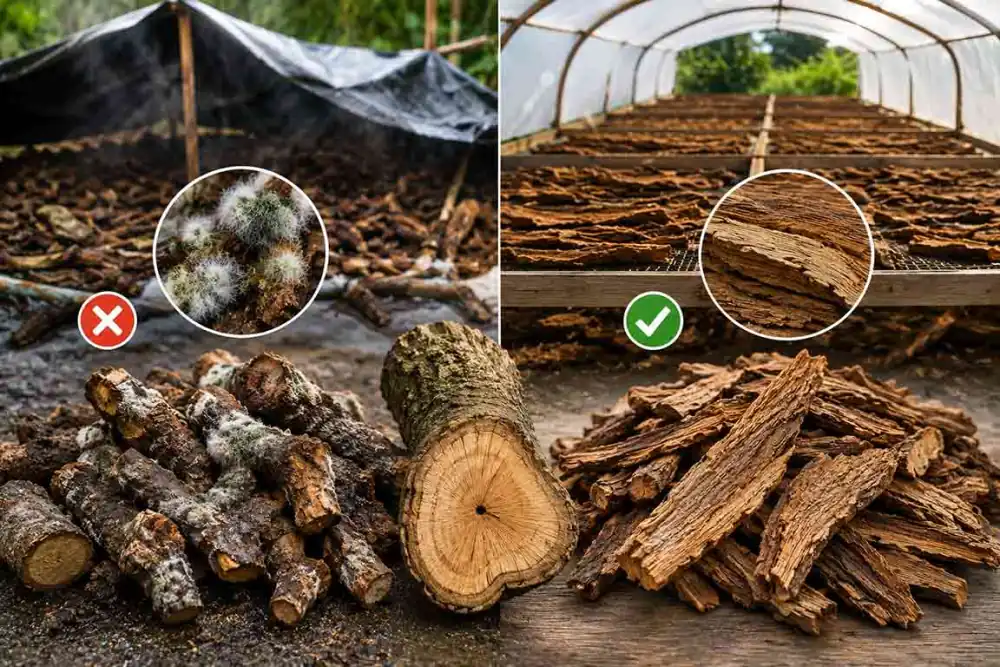
A batch of Mimosa Hostilis Root Bark (MHRB) can look perfectly fine on day three and be laced with gray mold by day ten. Nothing about the harvest changed — the root bark was still just as fresh, still just as clean when it came out of the ground. What changed was the moisture sitting inside it, and how little time it was given to leave.
MHRB is one of the trickiest bark products to dry well, and it’s exactly the kind of material where rushing shows up fastest. Suppliers of Mimosa tenuiflora — also known as jurema preta or tepezcohuite — routinely note that thorough washing and ventilated drying are the two things standing between a clean batch and a moldy one, with proper air-drying typically taking roughly four to eight days in shade before the bark is considered stable. Root bark is denser and holds more moisture than trunk bark, and that density is exactly what turns a rushed drying job into a moldy one.
This article breaks down why rushed MHRB batches mold, what actually needs to happen at a biological level for root bark to cure safely, and how to build a drying process that gets it right the first time — whether you’re preparing bark for natural dye work, tannin extraction, skincare formulation, or general botanical storage.
The Real Reason Rushed MHRB Goes Moldy
Mold does not care how the bark looks or feels on the surface. It cares about one number: water activity, often written as a_w. This is different from moisture content, and confusing the two is the single biggest reason home processors end up with a bag of fuzzy root bark a month after purchase or harvest.
Moisture content is simply the percentage of the material’s weight that is water. Water activity measures how much of that water is actually available for microorganisms to use. Drying reduces the moisture content of plant material from roughly 80 percent down to around 10 percent, and this reduction is what lowers water activity to the point where spoilage organisms and pathogens struggle to survive, extending storage life meaningfully.
The problem is that root bark can feel dry on the outside while the water activity inside is still high enough to support mold growth. This is especially true for MHRB, since it’s typically processed and sold as shredded or whole root pieces rather than thin strips — the outer surface dries and hardens while the denser interior is still holding onto significant moisture. Rushed batches almost always fail here: the bark looks dry after a couple of days, gets bagged or jarred, and mold blooms from the inside out over the following weeks because the interior never actually reached a safe water activity level.
The target for safely dried plant material generally sits at a water activity below 0.6, low enough to stop even the xerophilic, dry-loving molds that can survive where ordinary molds cannot. Most home setups can’t measure water activity directly, but understanding that this — not “looks dry” — is the actual finish line changes how the whole process should be approached.
What Makes Root Bark Different From Trunk Bark or Leaves
Most general drying guides are written with leaves and thin bark strips in mind, and applying those timelines directly to MHRB is where a lot of rushed, moldy batches start.
Root bark is structurally different from trunk or branch bark. It’s denser, thicker, and tends to hold moisture longer relative to its size. Reputable suppliers describe their process specifically around this: root bark is washed to remove soil and debris, then dried with active ventilation, because without airflow the moisture trapped in dense root tissue has nowhere to go. One established supplier notes their bark dries at roughly 70 percent shade over several days before grinding, a detail that reflects how much airflow and indirect light — rather than direct sun and heat — matter for this particular material.
Bark moisture content in general can vary enormously depending on the species, how it was stored, the season it was harvested in, and the debarking method used, with fresh bark sometimes carrying more than its own dry weight in water immediately after harvest. Root bark tends toward the higher end of that range because roots grow in consistently moist soil, unlike aerial bark that’s exposed to sun and wind even before harvest.
This is also why MHRB benefits from being processed into smaller pieces — shredded rather than left as thick whole-root chunks — before drying rather than dried in large sections. Reducing the surface-to-core distance is the single most effective way to shorten drying time without adding heat, since it gives moisture a shorter path out of the tissue. Suppliers who sell both whole and shredded MHRB generally note longer, less predictable drying times for the whole-root form for exactly this reason.
Building a Drying Environment That Actually Works
Good MHRB drying comes down to three variables working together: temperature, airflow, and humidity. Rushed batches typically get one of these wrong — usually by skipping ventilation entirely or drying in a sealed, humid space to avoid direct sun.
Temperature. Shade drying at ambient or slightly warm temperatures is the standard described across MHRB suppliers, rather than high heat. Suppliers report drying times of roughly four to eight days for shredded root bark under partial shade with active airflow, and around a week for less-processed batches dried more slowly. High heat is generally avoided, both because it risks degrading the bark’s natural color and aromatic qualities and because — just as with other bark types — it can harden the outer layer into a shell that traps interior moisture rather than releasing it.
Airflow. Stagnant air is where mold gets its opening, and this matters even more for a dense material like root bark than for thin leaves. Suppliers who emphasize quality consistently point to ventilation as the deciding factor between clean batches and contaminated ones. Practically, this means not piling washed root bark into a dense heap and not drying it inside a closed container — every piece needs open air moving across it, and pieces should be turned or redistributed periodically so no section sits compressed against a damp surface for long.
Humidity. Ambient humidity sets the ceiling on how fast and how safely a batch can dry. In naturally humid climates or seasons, fighting high ambient moisture with more heat tends to backfire — it dries the surface fast while leaving the interior wet, the exact combination that produces moldy pockets inside otherwise “finished-looking” bark. Better airflow, shorter pieces, and if necessary a dehumidified drying space handle humid conditions far more reliably than heat does.
Curing: The Step Rushed Batches Skip Entirely
Drying and curing get used interchangeably, but they aren’t the same step, and skipping the distinction is where a lot of “properly dried” MHRB still goes wrong.
Drying is the relatively fast removal of surface and near-surface water by evaporation. Curing is the slower stage after that, where residual moisture deep inside a piece has time to migrate outward and equalize with the drier exterior. For a dense material like root bark, this gap between “looks dry” and “is actually dry all the way through” can be significant — far more than for a thin leaf, where surface-dry and core-dry happen almost simultaneously.
Rushing past curing is exactly how MHRB that “felt done” after a few days in the shade ends up moldy in a sealed bag a few weeks later. Packaging root bark too soon traps that lingering internal moisture with no airflow to carry it away — precisely the conditions mold needs, and precisely why reviews and quality complaints about MHRB batches so often describe mold discovered after the product was already sealed and shipped, rather than during drying itself.
The fix is a short open-air resting period after the initial drying phase and before final packaging or grinding. Spread the dried root bark loosely in a single layer, uncovered, for a few additional days, and check daily for any softening, cool-to-the-touch dampness, or condensation on the inside of a temporary storage container. If anything feels the least bit pliable, it goes back out for more air time before it’s sealed for good.
Recognizing the Difference Between Dry and Cured
Since water activity isn’t something most people can measure directly at home, reliable field checks matter.
Root bark that is properly dried should feel firm and dry throughout, not just on the exposed surface — pieces that feel spongy, cool, or the least bit flexible anywhere along their length aren’t ready, no matter how long they’ve been sitting out. Checking multiple pieces from a batch, especially the thickest ones, gives a far more reliable read than checking just the thinnest or most exposed piece.
Weight is a useful secondary signal. Freshly harvested root bark can be substantially heavier than fully dried bark, so a batch that hasn’t noticeably lightened is very likely still holding onto moisture that a surface check alone won’t catch.
Smell and appearance round out the check. Properly cured MHRB should have a clean, characteristic aroma without any musty, sour, or damp note, and no visible fuzz, discoloration, or spotting — quality-focused suppliers explicitly flag “no mold spots” as a marker of a well-handled batch. A musty smell is often the first sign of trouble and tends to show up before visible mold does, so it’s worth trusting a change in smell over a quick visual glance.
If a problem is caught early — a slightly damp smell, a piece that feels cool or springy rather than dry — the fix is to spread the batch back out with better airflow and give it more time. Trying to “finish” a borderline batch inside a sealed bag removes the one thing that was actually helping it dry.
Storage Mistakes That Undo a Good Drying Job
Properly cured MHRB can still mold in storage if the packaging step undoes the work. This is where a lot of otherwise careful processing gets lost, because it feels like the hard part is already behind you.
Fully dried and cured root bark should be kept in airtight, moisture-blocking containers, away from heat, light, and humidity — several established sources on MHRB storage recommend temperature-controlled conditions ideally below roughly 25°C (77°F), noting explicitly that excess humidity is what leads to mold and deterioration in storage, even in bark that was dried correctly to begin with. Adding a food-safe desiccant packet to a storage container gives an extra buffer against humidity swings, particularly for bark stored in more humid regions or seasons.
Periodic checks matter as much as the initial packaging. A practical habit is inspecting stored bark every couple of weeks for any sign of discoloration, mold, or off odors, and repackaging into a fresh container with a new desiccant if any moisture is detected — catching a slightly damp batch early is far easier than salvaging one that’s already gone moldy throughout.
Labeling containers with the harvest or purchase date is worth the extra effort too, since it lets you track how long a batch has been stored and catch aging material before it becomes a risk rather than after. This matters because different root bark batches — depending on how they were harvested, washed, and dried — can vary meaningfully in how long they store well, and treating every batch as identical ignores exactly the variability that causes uneven drying and storage outcomes in the first place.
A Practical Framework: Batch Size, Timing, and Checks
Pulling this together, an MHRB batch that avoids the “rushed and moldy” outcome tends to follow a similar shape:
- Wash thoroughly before drying. Removing soil and debris up front reduces the microbial load the drying process has to outrun.
- Shred or cut into smaller pieces rather than drying whole-root sections. Smaller pieces shorten the distance moisture has to travel to escape.
- Dry in shade with active ventilation, not direct heat. Ambient shade drying with good airflow is the standard described across established MHRB processing methods.
- Don’t overcrowd the drying surface. Every piece needs open air on more than one side.
- Expect roughly four to eight days for shredded root bark, longer for whole-root pieces or in humid conditions — let the environment and the bark’s condition set the pace, not a fixed deadline.
- Rest the batch after it “looks” dry. A few extra days of open-air curing closes the gap between surface-dry and actually cured, especially for thicker root sections.
- Check multiple pieces, not just the easiest one, using firmness, weight loss, and smell together rather than any single test alone.
- Store only after all checks agree, in an airtight, labeled, moisture-blocking container in a cool, dark, low-humidity spot, with periodic inspection afterward.
None of these steps require special equipment. What they require is treating root bark’s drying timeline as genuinely different from thin bark or leaf material, and resisting the pull to package a batch the moment it looks finished on the outside.
The Bottom Line
Rushed MHRB batches go moldy for a specific, physical reason: the outer surface dries and firms up well before the dense interior does, and sealing that mismatch into an airtight container creates a humid pocket that mold thrives in. The fix isn’t more heat or a shorter timeline — it’s smaller pieces, real ventilation, and an honest curing period after the bark “looks” done, checked with a firmness test, a weight check, and a smell check before anything goes into long-term storage.
Given the extra few days that dense root bark actually needs, a batch that would otherwise mold in a sealed container within weeks can instead stay clean, aromatic, and usable for natural dye, tannin, or skincare applications for a long time on the shelf.