
Library
Mimosa Hostilis Root Bark Anatomy: Understanding Inner Root Bark, Quality, and Tannin Chemistry
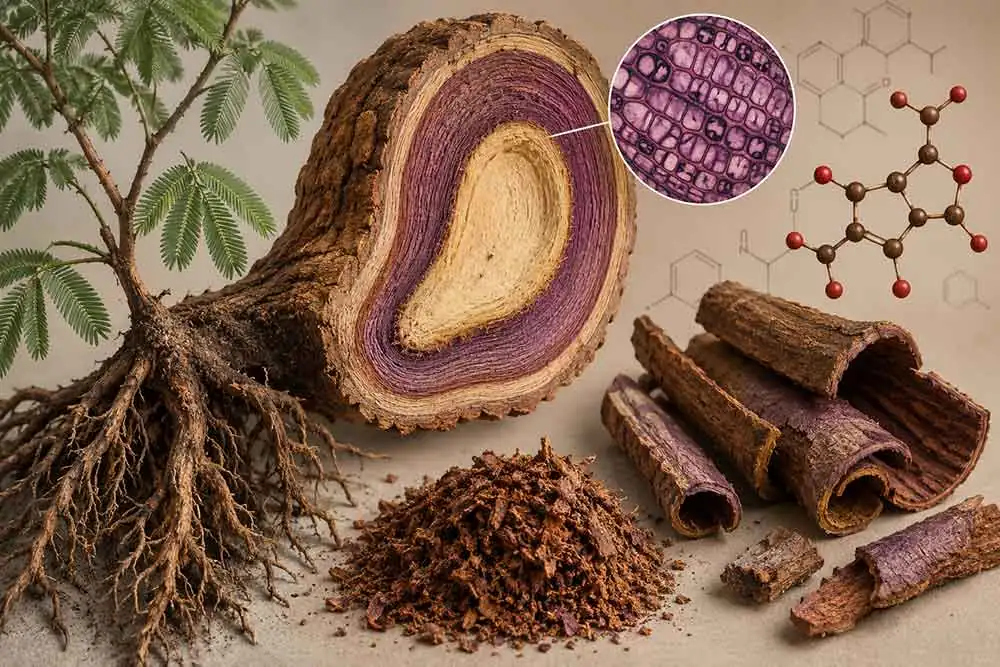
When people buy Mimosa hostilis root bark (MHRB), they often expect every piece to have a perfectly clean, uniform exterior. A small amount of rough or scaly material on the surface can therefore raise questions about whether the bark contains unwanted outer bark or other material.
Much of this confusion comes from using botanical terms interchangeably. Understanding the actual anatomy of root bark, along with the underlying cell biology and tannin chemistry, makes it easier to distinguish normal surface variation from genuine quality concerns — and to understand why this material behaves the way it does when used for natural dyeing.
What Is Inner Root Bark?
The term inner root bark generally refers to the living bark tissue located beneath the protective outer layers of a woody plant. In Mimosa hostilis, this tissue is primarily associated with the secondary phloem.
Secondary phloem sits between the vascular cambium and the outer protective tissues. It is a living, fibrous part of the plant and contains various naturally occurring compounds, including tannins, pigments, flavonoids, and polysaccharides.
Secondary phloem is composed of several distinct cell types working together:
- Sieve tube elements and companion cells — conduct sugars through the plant
- Phloem fibers — provide structural rigidity and are often lignified, which is part of why the inner bark has a fibrous, stringy texture once dried and separated from the wood
- Phloem parenchyma — stores starches, tannins, and other metabolites
In many Fabaceae species — the family Mimosa hostilis belongs to — the phloem fiber bands are particularly well-developed, contributing to the material’s characteristic texture.
This distinction matters because a piece of root bark can have a slightly rough exterior without being composed primarily of thick outer bark. Surface appearance alone does not necessarily tell you which anatomical layer makes up the majority of the material.
Understanding the Outer Bark: Rhytidome
The thick, dark outer surface associated with mature Mimosa hostilis trunks is known botanically as the rhytidome.
Rhytidome develops through the activity of a secondary meristem called the phellogen (cork cambium). The phellogen produces phellem (cork) cells outward; these cells become suberized — impregnated with the waxy polymer suberin — and die at maturity, forming the corky, water-resistant outer layer. Periodically, a plant initiates a new phellogen deeper in the tissue, isolating and killing the bark tissue outside it. Repeated rounds of this process produce the layered, fissured appearance typical of mature trunk bark.
Rhytidome is made up largely of dead, protective tissue. Its job is to shield the living tissues underneath from environmental stresses such as drying, ultraviolet exposure, temperature changes, and physical damage. On the trunk, this outer protective layer can become thick, deeply furrowed, and highly textured — visually very different from the reddish or purple interior tissue found beneath the bark.
However, the structure of bark changes as you move from the trunk into the root system. The thick protective exterior associated with the trunk does not simply continue underground in exactly the same form.
How Root Bark Differs From Trunk Bark
One of the most important points in understanding MHRB anatomy is the difference between trunk bark and root bark.
The trunk is exposed to sunlight, temperature fluctuations, wind, physical abrasion, and drying conditions. These environmental pressures drive repeated phellogen activity and contribute to a substantial protective outer layer.
Roots experience a different environment. Underground tissues are not exposed to direct ultraviolet radiation or the same atmospheric conditions as the trunk. As a result, root systems generally undergo fewer, thinner rounds of phellogen activity, and the outer protective layer becomes considerably thinner as the structure transitions from trunk into root.
This means a root-bark piece may occasionally retain a small amount of surface texture without containing the thick, heavily developed outer bark associated with the trunk.
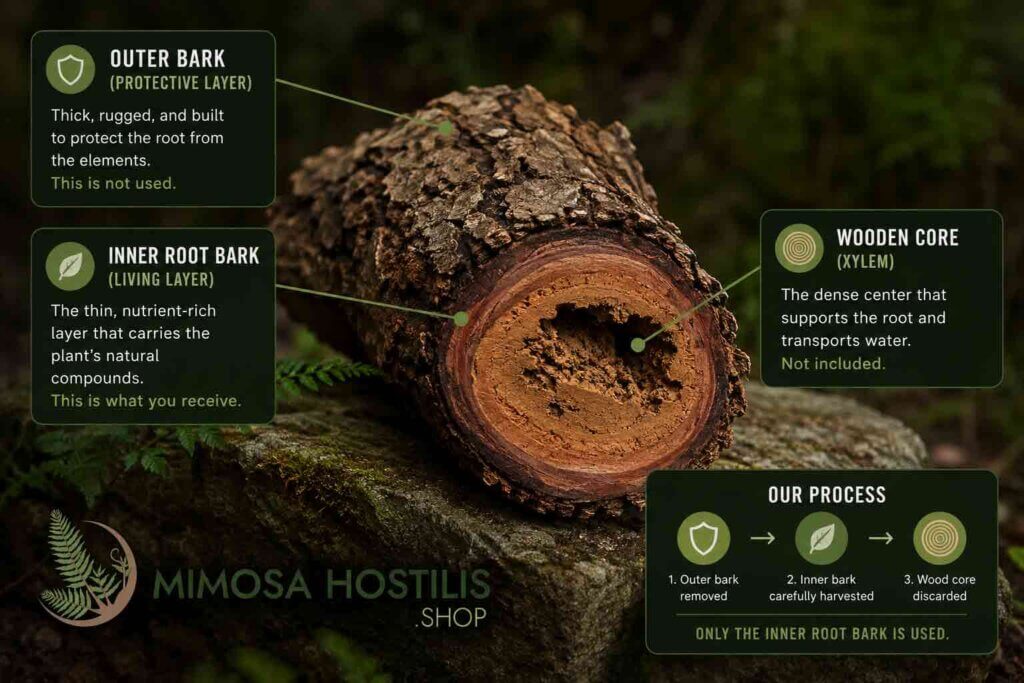
The Four Main Layers of the Plant
Looking at a cross-section of woody plant material provides a clearer picture of what each layer does.
1. Rhytidome
The external protective bark structure, especially prominent on mature trunks, where it can appear dark, hard, and heavily textured. On processed root material, only a much thinner remnant may remain on portions of the surface.
2. Secondary Phloem
The living inner bark located beneath the outer protective tissues. This layer transports nutrients throughout the plant and contributes much of the characteristic fibrous, pigmented appearance associated with the inner bark of Mimosa hostilis. It also stores the naturally occurring tannins and other plant compounds most relevant to dyeing.
3. Vascular Cambium
A very thin layer of actively dividing cells positioned between the phloem and xylem. It produces new phloem toward the outside and new xylem toward the inside. Although biologically important, it is not normally considered a significant commercial component of processed root bark.
4. Xylem
The woody portion of the plant. Xylem is dominated by lignified cell walls — tracheids and vessel elements reinforced with lignin, a rigid aromatic polymer that gives wood its structural strength. Unlike phloem tissue, xylem contributes little in the way of soluble polyphenolic compounds, which is the practical basis for why bark-to-wood separation matters more for dye quality than surface smoothness does. Cross-contamination with xylem dilutes tannin-rich material with structurally inert, low-pigment wood fiber.
Why Some MHRB Pieces Look Rough or Scaly
A common misconception is that every visible rough patch on a piece of MHRB represents a substantial layer of unwanted outer bark.
In reality, processed botanical material naturally varies in appearance. Some pieces may have relatively smooth surfaces, while others show thin, scaly, or textured areas. These surface characteristics often represent residual cork cells from a thin, incomplete phellogen layer rather than a thick layer of trunk-like rhytidome. A thin surface remnant should not automatically be interpreted as evidence that the material is primarily outer bark.
The original article reports side-by-side comparisons of pieces with differing amounts of visible surface texture and states that the observed differences did not produce meaningful changes in dye yield, color depth, or tannin extraction.
Tannins and Pigmentation
The reddish-purple coloration associated with MHRB’s inner bark is generally attributed to condensed tannins (proanthocyanidins) and related polyphenolic compounds stored in phloem parenchyma cells. Condensed tannins polymerize and oxidize on exposure to air and light, which is part of why color can deepen or shift with age and processing.
Tannin concentration in bark tissue is known in many plant species to vary with several factors:
- Season of harvest — tannin biosynthesis often peaks during certain growth phases
- Water stress — tannin production is frequently upregulated under drought conditions as part of general phenolic stress responses
- Tissue age — younger phloem tends to have proportionally more soluble, low-molecular-weight tannins, while older tissue accumulates more polymerized, less soluble tannins
- Growing conditions — soil composition and environmental factors contribute to differences in cellular structure and chemical composition
This is consistent with the idea that two harvests of the same species can differ noticeably in dye yield without either one being “wrong” — polyphenol content is inherently variable in plant tissue, not a fixed constant.
Extraction Chemistry for Natural Dyeing
For dye and leather-coloration applications, the practical goal is to get the tannins and pigments out of the plant material and into solution efficiently. A few basic chemistry principles are relevant here:
Water temperature: Condensed tannins are generally more soluble in warm water than cold, so most natural-dye protocols call for simmering bark material well below boiling (roughly 60–85°C / 140–185°F) rather than a hard boil. Excessive heat and prolonged boiling can degrade some polyphenolic compounds and drive off volatile fractions, sometimes dulling rather than deepening the resulting color.
pH sensitivity: Many condensed tannins and their associated pigments are pH-sensitive. Extraction and dye baths tend to shift toward:
- More acidic conditions (lower pH): often yields warmer, redder tones, since anthocyanin-like and tannin-derived pigments tend to be more stable and vivid in acidic solution
- More alkaline conditions (higher pH): can shift color toward purple, gray, or brown, and may also affect how readily the pigment binds to fiber or leather
This is why small additions of acid (such as citrus juice or vinegar) or alkali (such as baking soda) are common variables in natural dye recipes — they aren’t just tradition, they’re adjusting the chemical environment the tannins are dissolved in.
Extraction time and particle size: Because tannins are stored inside phloem parenchyma cells, smaller particle sizes (shavings or powder versus whole bark chunks) increase the surface area exposed to water and speed extraction. Longer soak or simmer times generally continue to pull tannins into solution up to a point of diminishing returns, after which further heating mostly affects color stability rather than yield.
Mordanting: Because raw tannin-dyed fiber or leather can be prone to fading or uneven binding, many processes use a mordant — a metal salt (such as alum or iron) that forms a coordination complex with the tannin molecules and helps anchor them to the fiber structure. Iron mordants in particular tend to “sadden” tannin dyes, shifting reddish tones toward darker purples, grays, or near-black, which is a well-documented interaction between iron ions and polyphenolic tannin structures.
Why Some MHRB Pieces Look Rough or Scaly — Summary
Taken together, these anatomical and chemical points explain why surface appearance is a poor proxy for dye quality: the pigments and tannins responsible for dye performance live in the phloem parenchyma, not in the thin residual cork layer on the surface. A rough patch of surface tissue contributes negligible tannin content one way or the other.
What to Look for When Evaluating MHRB
For buyers interested in MHRB for legitimate applications such as natural dyeing, leather coloration, soap making, or botanical material research, sourcing information can provide useful context.
Look for clear information about the plant source, harvesting practices, processing methods, and separation of woody material. A transparent supplier should also explain how natural variation is handled rather than suggesting that every piece must have an identical appearance.
The original source describes its material as root-derived, with the woody core separated during processing, while also emphasizing that some surface variation is normal.
A Better Way to Understand Root Bark Quality
The biggest lesson is that clean-looking does not always mean botanically superior.
Root bark is a natural plant material, so differences in pigmentation, fiber structure, thickness, and surface texture are expected. A small amount of visible texture should be interpreted in the context of the complete anatomical structure — and the underlying tannin chemistry — rather than automatically classified as contamination or poor-quality bark.
Understanding the difference between rhytidome, secondary phloem, cambium, and xylem — along with how tannin solubility responds to temperature, pH, and particle size — provides a much more accurate framework for evaluating MHRB and predicting how it will perform in a dye bath.
Final Takeaway
Mimosa hostilis root bark anatomy is more nuanced than its appearance suggests. The thick, dark protective bark associated with the trunk is different from the inner bark found within the root system, and the compounds that actually matter for dyeing — condensed tannins stored in phloem parenchyma — are governed by extraction chemistry (temperature, pH, particle size, mordanting) far more than by surface smoothness. Small areas of surface texture occur naturally and should not automatically be mistaken for substantial outer bark or poor material quality.
By understanding the plant’s anatomy, its cell biology, and the basic chemistry of tannin extraction, buyers and crafters can make more informed decisions about sourcing, processing, and using root-bark material for legitimate dye and craft applications.
For legitimate uses such as natural dyeing and botanical material research, always follow applicable local laws, supplier guidance, and relevant safety requirements.