
Library
Jurema in Afro-Brazilian Religion: The Overlooked Spiritual Dimension of a Botanical Trend
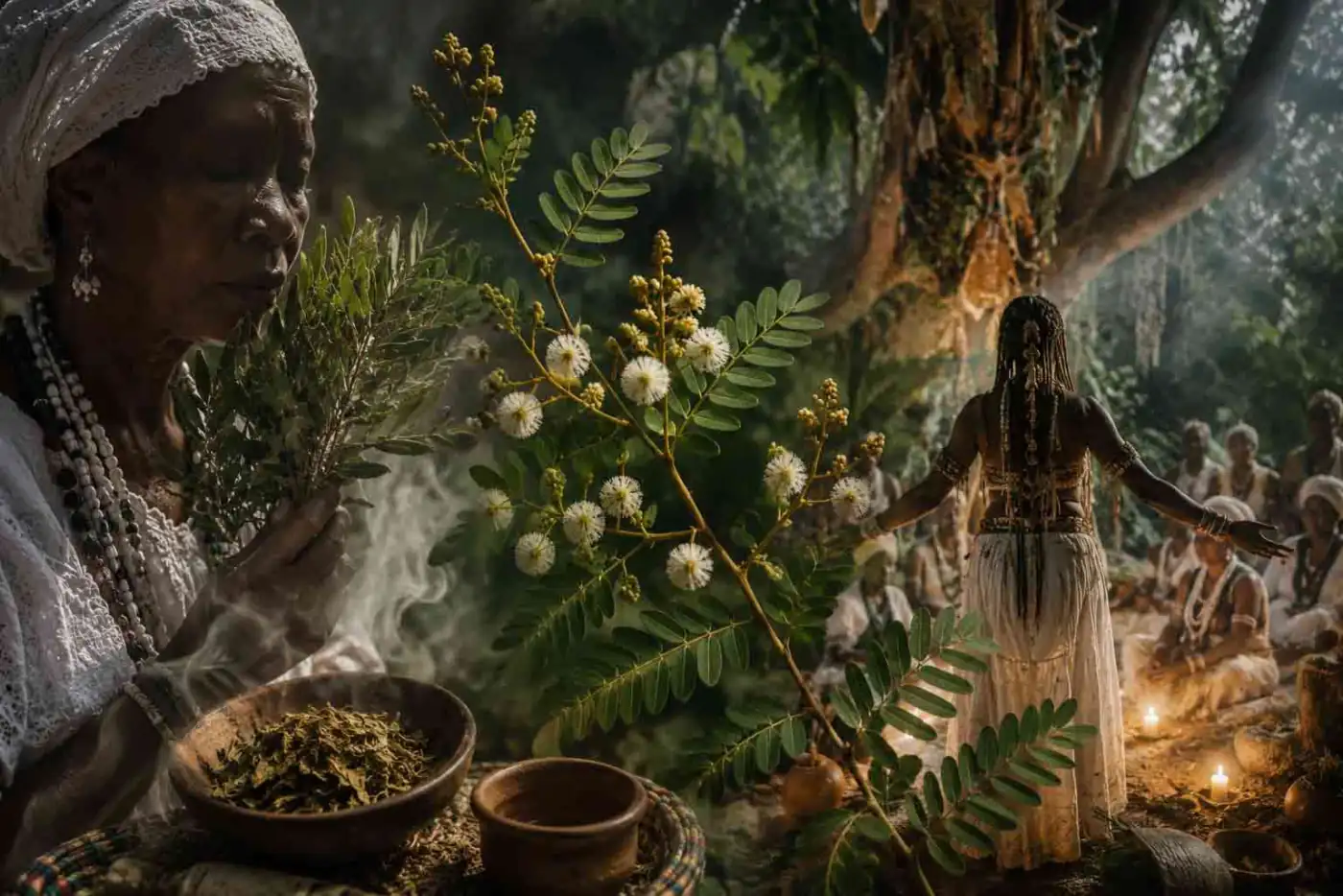
- Jurema (Mimosa hostilis / Mimosa tenuiflora) is not simply a psychedelic plant — it is the spiritual axis of one of Brazil’s oldest living religious traditions, Jurema Sagrada.
- The tradition pre-dates European colonization among Tupi and other northeastern Brazilian Indigenous peoples, and has survived more than three centuries of persecution by the Catholic Church and colonial authorities.
- Jurema Sagrada integrates Indigenous shamanism, West African spiritual practices, popular Catholicism, and Kardecist Spiritism into a unique syncretic system recognized today as Brazilian Intangible Cultural Heritage.
- The global botanical market’s growing interest in Mimosa hostilis root bark — driven by its DMT content — risks extracting the plant entirely from the spiritual context that gave it meaning.
- Responsible engagement requires understanding the living tradition: its pantheon of Mestres and Caboclos, its ritual geography, and the communities who have kept it alive against enormous odds.
What the Botanical Trend Gets Wrong About Jurema
When Mimosa hostilis root bark began appearing on ethnobotanical shelves and psychedelic research forums in the early 2010s, the conversation centered almost entirely on one molecule: N,N-dimethyltryptamine, or DMT. Researchers, wellness seekers, and harm-reduction communities debated extraction methods, dosage, and therapeutic potential. Scientific journals published findings. ScienceAlert reported in 2025 on physicist Dráulio Araújo’s DMT research — originally published in Nature in April 2024 — exploring jurema preta as a potential treatment for treatment-resistant depression.
What largely disappeared from these conversations was the tree’s spiritual identity. Mimosa hostilis is not a raw botanical compound waiting to be optimized by Western pharmacology. It is the sacred axis of Jurema Sagrada — a living Afro-Indigenous Brazilian religion with unbroken lineages stretching back before European contact. To understand Jurema the plant, you must first understand Jurema the tradition.
As journalist Marcelo Leite, who documented the tradition in his recent book on the sacred use of Jurema in Northeastern Brazil, noted in a 2025 Chacruna Institute interview: the history of Jurema is one of remarkable resilience, with rituals performed at least since the 18th century according to historical documents — and likely for centuries or millennia before that — despite ongoing repression and persecution.
The Three Meanings of Jurema
In Brazil, the word jurema carries at least four simultaneous meanings, a linguistic richness that already signals its cultural depth:
- A sacred tree — Mimosa hostilis (also classified as Mimosa tenuiflora), particularly the black jurema (Mimosa hostilis Benth) and white jurema (Mimosa verrucosa Benth), considered sacred by Indigenous peoples and mestiça populations primarily in Brazil’s Northeast.
- A ritual beverage — a decoction prepared from the root bark and leaves of the tree, ritually consumed in ceremonies; its psychoactive properties come from its DMT content, activatable when combined with a monoamine oxidase inhibitor (MAOI).
- A living religious tradition — the complex of spiritual, therapeutic, and ceremonial practices known collectively as Jurema Sagrada, Catimbó, or simply “the Jurema,” integrating Indigenous, African, Catholic, and Spiritist elements.
- A spiritual entity — Cabocla Jurema, the most important of the Cabocla spirits, described in the Occult World encyclopedia as “the spirit of the sacred Jurema tree,” presiding over the Caboclos’ mythic paradise and venerated across Umbanda, Catimbó, and independent practice.
This layering is not metaphorical. In Jurema Sagrada, the plant, the drink, the spirit, and the sacred realm all share the same name because they are understood to be the same living presence — a bridge between the botanical and spiritual worlds.
Pre-Colonial Roots: The Tupi Peoples and the Jurema Kingdom
The historical roots of Jurema worship stretch back to pre-Columbian times among the Tupi peoples of what is now northeastern Brazil — particularly in the states of Pernambuco, Paraíba, Rio Grande do Norte, and Alagoas. Among these peoples, the Jurema tree occupied a central position in shamanic cosmology. The pajé (shaman) served as the intermediary between the human community and the enchanted world (encantaria) — the invisible dimension accessible through trance, ritual, and the Jurema drink.
The tradition has certainly existed much longer than the European discovery of Brazil, as scholars of the tradition note. Like Ayahuasca in Western Amazonia, the Jurema ritual complex was an integral part of northeastern Indigenous traditions since time immemorial, even if it was only first documented by outside observers in the 18th century.
What made Jurema distinctive within the broader landscape of Indigenous Brazilian spirituality was its mythogeography: the tradition mapped an entire invisible universe of Kingdoms of Jurema — spiritual realms with their own cities, kings, queens, and landscapes. Practitioners did not merely consume a plant; they traveled to these kingdoms during trance, receiving healing knowledge, prophecy, and blessings from their inhabitants.
Three Centuries of Persecution
The encounter with Portuguese colonialism was violent for the Jurema tradition. Starting with Jesuit missionary campaigns in the 16th century, Indigenous ceremonies were systematically suppressed. The collection of shamanic-spiritual traditions then summarized under the term Catimbó was persecuted and suppressed until the middle of the 20th century. The Portuguese Inquisition, which maintained an active presence in Brazil through its colonial tribunals, targeted practitioners of Catimbó — the Afro-Indigenous syncretic form of Jurema — as practitioners of sorcery and devil-worship.
Colonial repression had two paradoxical effects. On one hand, it drove ceremonies into the forests and mountains of the semi-arid northeastern region, where they were held in secret. Pajés and juremeiros maintained strict secrecy around the preparation of their beverage and the details of their rituals — a practice that, as Leite notes in his 2025 Chacruna interview, continues to this day. On the other hand, forced contact between different Indigenous groups during missions, and between Indigenous and African communities in quilombos (communities of escaped enslaved people), accelerated the tradition’s evolution into something new: a genuinely Afro-Indigenous synthesis.
The Inquisition’s targeting of both Indigenous spiritual practitioners and Africans who maintained their own religious practices in the same social spaces created what scholar Ronaldo Vainfas has described as a zone of “spiritual bricolage” in northeastern Brazil — a space where Indigenous shamanism, West African spiritual technologies, and European folk magic merged under pressure, producing new traditions that outlasted their oppressors.
The Syncretic Architecture of Jurema Sagrada
By the 19th and early 20th centuries, what had been dispersed Indigenous ceremonial practice had crystallized into the recognizable complex of Jurema Sagrada. The tradition’s syncretic structure — what Brazilian scholars sometimes describe using the metaphor of “three waters” (três águas) flowing into one river — reflects its multiple tributary sources:
- Indigenous shamanism provided the foundational cosmology: the Kingdoms of Jurema, the role of the pajé, the use of tobacco and the Jurema drink, and the concept of traveling to enchanted worlds.
- West African spiritual traditions — brought by enslaved Yoruba, Bantu, and other African peoples — contributed structural elements of spirit possession, initiation hierarchies, and specific entities that entered the Jurema pantheon.
- Popular Catholicism contributed saints who became syncretized with Jurema entities, as well as the calendar of feast days around which ceremonies are organized.
- Kardecist Spiritism, which arrived in Brazil in the mid-19th century, introduced concepts of spiritual evolution and the mediumistic practices that became central to Jurema Sagrada’s ceremonial form.
By the 20th century, as Chacruna Institute documents, the tradition began incorporating elements from Kardecism through Umbanda — another syncretic Brazilian faith. This layering was not dilution. As the exurei.com analysis of the tradition notes: this was not cultural dilution, it was cultural genius. The tradition now known as Jurema Sagrada represents one of the most successful examples of syncretic spiritual evolution in the Americas.
The Pantheon: Mestres, Caboclos, and Encantados
The spiritual universe of Jurema Sagrada is populated by a pantheon of encantados — enchanted beings who did not die in the conventional sense but “enchanted themselves” into invisible existence and remain available to human communities through ritual.
Three primary categories organize this pantheon:
Caboclos are ancestral spirits linked to nature, Indigenous identity, hunting, and the forest. They represent the original inhabitants of Brazil — in death (or enchantment) becoming spiritual guides and healers. In the Umbanda tradition, caboclos are understood as indigenous Brazilian spirits sent by the orixás as emissaries. In Jurema Sagrada, they occupy an even more foundational role, as the tradition itself originated in Indigenous soil.
Mestres (Masters) — literally “Master Healers” — are spirits of both African and European derivation who serve as teachers and spiritual directors. The Occult World encyclopedia notes that in the context of Jurema, figures like Maria Padilha are classified as Mestres. Among the most venerated are Zé Pelintra, Maria do Acais, Mestre Carlos, Caboclo Aboiador, Reis Canindé, and Malunguinho — each with distinct personalities, domains, and ritual requirements. When a Mestre “manifests” through a medium, those present can immediately identify which encantado is present through distinctive changes in the medium’s voice, posture, and mannerisms.
Cabocla Jurema herself presides over the entire system. She is simultaneously the consciousness of the sacred tree, the ruler of the mystical realm of Jurema, and a spirit with a distinct personality and domain. The exurei.com tradition describes her as the Queen of Hunters, belonging to the spiritual line of Oxóssi in Yoruba-based traditions — connecting the Jurema system to the broader Afro-Brazilian cosmological universe while maintaining her specifically Indigenous identity.
During ceremonies in the terreiro (the sacred ritual space), practitioners invite these entities to “come down” — to possess mediums who have been prepared through initiation to receive them. As Chacruna documents, they come down to offer advice, blessings, and recommendations for plant medicines, prayers, or herbal baths, helping attendees alleviate their suffering.
The Ritual Geography: Kingdoms, Cities, and Sacred Axes
One of Jurema Sagrada’s most distinctive features — and one almost entirely absent from botanical and psychedelic discourse — is its elaborate spiritual geography. The Kingdoms of Jurema are not abstract metaphysical concepts; they are mapped territories with specific rulers, atmospheric qualities, and spiritual specializations.
Practitioners speak of journeying to cities and kingdoms during ceremony — sometimes through trance induced by the Jurema wine, sometimes through possession, sometimes through the collective force of chanting and percussion. Each kingdom specializes in different healing powers and is presided over by different royal entities. A practitioner seeking healing for a specific condition would invoke the appropriate kingdom and its rulers.
This spatial-spiritual imagination — the idea that the healing traditions of different regions and peoples exist simultaneously in an invisible dimension accessible through ceremony — is perhaps the Jurema tradition’s most profound contribution to global spiritual thought. It offers a model of spiritual pluralism that is not merely tolerant of difference but architecturally organized around it.
Jurema and Umbanda: Negotiated Coexistence
The relationship between Jurema Sagrada and Umbanda — Brazil’s most widely practiced Afro-Brazilian religion, with an estimated 30 million adherents — is one of the most complex in Brazilian religious history. Umbanda emerged in the early 20th century as a deliberate synthesis of multiple traditions, and it incorporated Jurema entities into its own pantheon, giving Cabocla Jurema a prominent place among its spiritual figures.
But this incorporation was not without conflict. As the academic journal Cada Jurema é uma Jurema documents, juremeiros — traditional Jurema practitioners — had to formally associate with Umbanda centers during the 20th century, incorporating Umbanda’s ritual practices in exchange for social legitimacy and protection from police persecution. Umbanda, in turn, included Jurema’s sacred figure in its pantheon, transforming her into a specifically female Indigenous archetype venerated among the Caboclos.
The juremeiros of Alhandra — one of the tradition’s heartland communities in Paraíba state, where the Catimbó-Jurema tradition emerged from the family of Inácio Gonçalves de Barros — do not recognize Umbanda’s legitimacy to represent their tradition. They maintain that Catimbó is not an appendix or subcategory of Umbanda, but an independent tradition that predates it by centuries.
This tension remains alive. In some regions of Northeastern Brazil, such as areas from Rio Grande do Norte to Alagoas, the Jurema cult is considered the gateway to religious initiation — neophytes first pass through Jurema rituals before being inserted into the practices of the orixás.
The Terreiro as Sacred Space
Jurema ceremonies take place in the terreiro — a term that translates literally as “yard” or “ground” but carries the weight of “sacred communal ground.” Terreiros are more than ritual spaces; they are community institutions providing healing, social support, and cultural continuity.
A typical Jurema ceremony involves:
- Rhythmic drumming on ilus (drums specific to the tradition) and maracá rattles, creating the sonic conditions for trance and spirit contact
- Communal chanting of invocations specific to each entity and kingdom
- Tobacco work — the blowing of tobacco smoke on those seeking healing is described in academic literature as “the most simple and most accessible of all Jurema healing rituals”
- Serving of Jurema wine — the ritual beverage prepared from the root bark, offered as sacrament; as Chacruna notes, the drink does not always produce psychedelic effects, possibly due to low doses or the absence of MAO inhibitors — its primary role is sacramental, not psychedelic
- Possession sequences in which trained mediums receive Mestres, Caboclos, and other entities who provide consultation, healing, and guidance to those present
The distinction between Jurema wine as sacrament and Mimosa hostilis as a psychedelic extraction source is perhaps the clearest marker separating the living tradition from the botanical trend. In the Jurema terreiro, the drink is consumed within an elaborate ceremonial context designed to make contact with specific spiritual entities. Extracted from that context, the same plant becomes a different — and spiritually meaningless — substance.
Heritage Recognition: A Hard-Won Victory
After three centuries of suppression, the Jurema tradition has achieved significant formal recognition in Brazil in recent decades. In November 2009, the cultural heritage designation body IPHAEP (the Pernambuco state equivalent of IPHAN) issued a positive decision recognizing the Catimbó-Jurema site in Alhandra, Paraíba, as cultural heritage — a process described in scholarly literature as “not without conflicts.”
At the federal level, IPHAN’s 2015 Cultural Heritage of Traditional Peoples and Communities of African Origin Award covered 31 nationwide initiatives, explicitly including jurema alongside Candomblé, Umbanda, and batuque as recognized Afro-Brazilian cultural heritage. The Brazilian Constitution’s Article 216 provides the framework, recognizing “forms of expression” and “means of creating, doing and living” as cultural heritage — categories that encompass living religious traditions.
This recognition matters not only symbolically. It provides legal protection for terreiros, community spaces, and traditional knowledge — the same traditional knowledge that the global botanical market now seeks to extract and commodify.
The Appropriation Problem: What Responsible Engagement Looks Like
The psychedelic renaissance of the 2020s has brought genuine scientific interest to the therapeutic potential of DMT-containing plants, including Mimosa hostilis. Physicist Dráulio Araújo’s research, published in Nature in April 2024 and in Psychedelic Medicine in the same year, represents serious scientific inquiry into ayahuasca and DMT’s antidepressant potential. This research deserves acknowledgment.
But serious scientific inquiry and respectful cultural engagement are not the same thing. The 2024 International Congress on Psychedelic Therapies, as reported by researchers in the field, saw Brazilian DMT researchers facing accusations of cultural appropriation and disrespect toward the sacredness of the Jurema tree, spirit, and religion. The tension is real and unresolved.
Responsible engagement with Jurema — whether from the perspective of researchers, wellness practitioners, or curious individuals — requires at minimum:
- Acknowledging the living tradition — Jurema Sagrada is not a historical artifact or a folk practice. It is an active religion with living practitioners, recognized lineages, and ongoing community life in northeastern Brazil and increasingly in urban centers like Recife, Salvador, and São Paulo.
- Distinguishing the plant from the tradition — Mimosa hostilis is the sacred body of a spiritual tradition. Its isolation as a DMT source represents a form of reductive extraction that parallels the colonial extraction of Brazil’s physical resources.
- Directing resources toward Jurema communities — The economic value now being generated by the global trade in Mimosa hostilis root bark does not flow to the communities that preserved the plant’s sacred use through centuries of persecution. This is a concrete injustice with concrete remedies.
- Learning the tradition’s own language — To speak meaningfully about Jurema requires familiarity with its cosmology: the Kingdoms, the Mestres, the Caboclos, the terreiro, the encantados. Reducing this to “a plant with DMT” is not neutral — it is a form of erasure.
Jurema Today: Resilience, Revival, and Global Reach
Despite — or perhaps because of — the global attention generated by psychedelic research, the Jurema tradition is experiencing a genuine revival. Urban terreiros in Recife, one of the tradition’s major centers, have maintained active practice and training of new mediums. The intersection with Candomblé in Recife has led to the development of new forms of syncretic ritual while keeping the Jurema lineage distinct.
At the same time, the tradition faces real challenges. Urbanization reduces access to the natural spaces in Northeastern Brazil where many ceremonies traditionally take place. Younger generations, drawn to global culture, do not always inherit traditional knowledge. There is ongoing tension between traditional juremeiros — particularly those from Alhandra — and practitioners who mix Jurema with Umbanda, Candomblé, or New Age practices.
Cabocla Jurema herself, in the tradition’s own terms, embodies the resolution to these tensions. She represents, as the Fandom Myth and Folklore Wiki notes, the very resistance of indigenous culture, which has survived to the present day through the secret rites of catimbó and encantaria. She is not a symbol of a lost past. She is a living force
Frequently Asked Questions
Sources
- Chacruna Institute — “The Enchanted Science of Jurema: DMT at the Root of Afro-Amerindian Rituals in Brazil” (June 2025):
- ScienceAlert — “Brazilian Psychedelic Plant Emerges as Potential Depression Treatment” (May 2025):
- SAGE Encyclopedia of Global Religion — “Jurema of the Brazilian North”:
- Wikipedia — “Mimosa tenuiflora”:
- Wikipedia — “Umbanda”:
- MDPI Religions — “(In)tangible Cultural Heritage and Religious Minorities” (April 2025):
- Occult World — “Jurema”:
- Redalyc — “Xangô, Jurema e Umbanda: anotações sobre três formas de religião popular na região do Recife”:
- Híbridos — “Jurema Sagrada”:
- Exu Rei — “Who is Jurema?”: