
Library
Eco Printing with Mimosa Hostilis: Using Bark Tannin for Sharper Leaf Prints
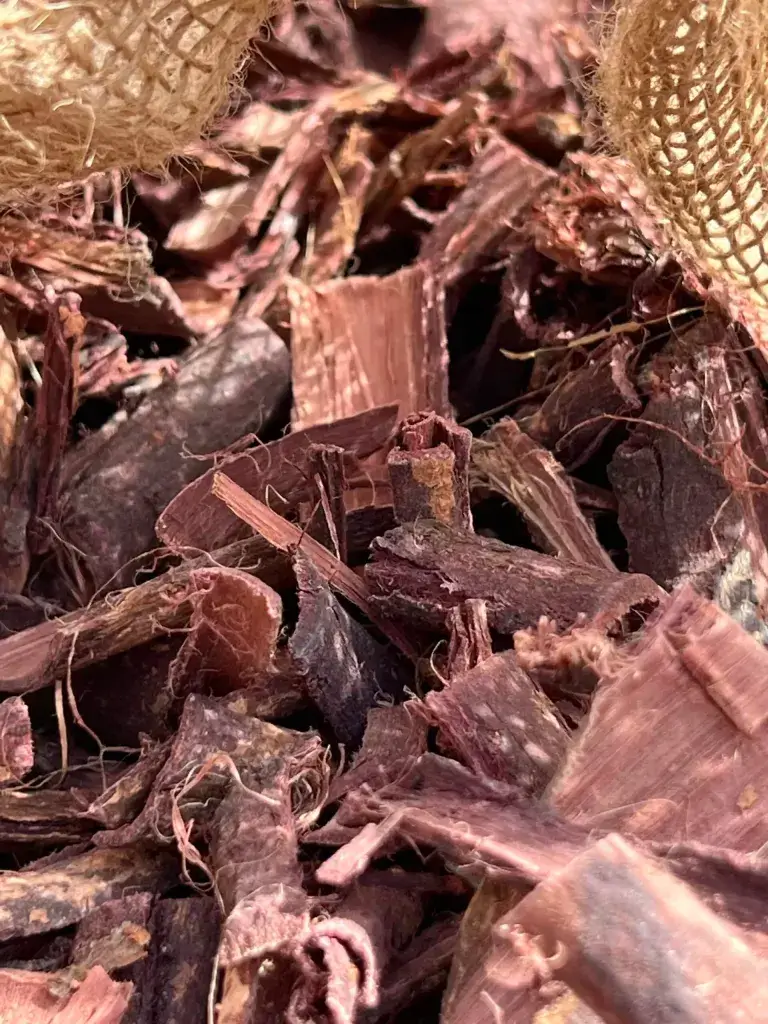
Eco printing is a contact print: fresh leaves pressed against cloth and steamed so the leaf itself marks the fabric. A Mimosa hostilis root-bark bath loads the cloth with tannin first. An iron-soaked blanket then darkens that tannin, which makes the leaf edge sharper than a leaf steamed on plain cloth.
This is not a tie-dye and it is not a stamp. The leaf is the printing plate. The bark is there to put tannin into the cloth, or into a second cloth laid over the leaves, so iron has something to react with. The steps below are a test bundle you can repeat. They are not a swatch chart from this shop. A finished print still depends on the leaf, the water, and how much iron you use.
Start with one scrap
Cut a piece about the size of a washcloth. Weigh it while it is dry. Use one kind of leaf. Steam it once. A scarf on the first try hides the mistake, because a loose roll and a heavy iron dose look the same when the cloth is large. The scrap tells you which thing to change.
Work in this order: scour, bark liquor, iron blanket, leaves, roll, steam, cool, rinse. Everything under those headings is the same sequence, with the reason for each step and what to do when the scrap comes out pale or blotched.
What eco printing is
India Flint published the method she calls the ecoprint after a 1991 accident with eucalyptus leaves and eggs, and she first presented it in 1999. Her account is on her plants-and-colour page: a leaf held against cloth, bundled tight, and heated, so the color moves from the leaf into the fibre. The book that carried the method further is Eco Colour (Murdoch Books, 2008). Dyers now say “eco printing” for that contact print, including bundles that add a tannin dip or an iron blanket.
The print is local. Color forms where the leaf touches the cloth and fades where it does not. A fold, a loose roll, or a leaf that sits proud of the surface leaves a blank. That is the opposite of a dye pot, where the whole cloth takes one bath. It is also the opposite of a carved block. Block printing with a mimosa ink is a separate process, covered in printing with mimosa tenuiflora ink.
Why the bark tannin changes the print
Many leaves already contain tannin. Iron reacts with that tannin and the mark goes darker, often with a clean edge. A leaf that is low in tannin can still print, but the mark is faint. Putting more tannin into the cloth, or into a cloth laid over the leaves, gives the iron a reserve to work on. The ground darkens around the leaf, and the leaf shape reads more clearly.
Mimosa tenuiflora root bark, sold as Mimosa hostilis or MHRB, is a condensed-tannin bark. A 2012 study of iron-tannate textiles in Heritage Science separates the two reactions dyers actually see. Hydrolysable tannins, the kind in oak galls, form blue-black complexes with iron. Condensed tannins, the kind in this bark, form dark green-black to brown complexes. That is chemistry, not a promise that your bundle will match a particular swatch. The paper also records the cost of extra iron: the same metal that makes the dark color speeds up damage in the fibre over time.
Dip the cloth
Simmer the bark, strain the liquor, and soak the scoured cloth in it before any leaf goes down. Wool and silk take plant color more readily than cotton and linen. Flint notes that a protein fibre will hold a leaf print with less help. Cellulose usually needs the tannin dip or the print stays pale. The full simmer, strain, and aftercare for a mimosa dye bath is the beginner’s guide to mimosa hostilis root bark dye. Use that for the pot. Use this page for the leaf.
Or dye a blanket
A tannin blanket is a second piece of cotton or linen, soaked in the same strained liquor and laid over the leaves. Where a leaf sits, it blocks the blanket, so the target cloth stays lighter there. Where there is no leaf, tannin transfers and the ground picks up color. An iron blanket is the same idea with ferrous sulfate in the second cloth instead of bark liquor. You can use one or the other. Using both at full strength is how bundles go muddy.
Materials
- Scoured natural cloth: wool, silk, cotton, or linen. Polyester will not take this print.
- Mimosa hostilis root bark, shredded or powdered. Powder gives a faster liquor. Strain either one so grit does not sit on the cloth.
- A second cloth for the blanket, about the same size as the piece you want to print.
- Ferrous sulfate (iron(II) sulfate), a scale, and gloves. A rusty-nail bucket has iron in it, but you cannot weigh the dose.
- Leaves you can name. A dowel or stick, cotton string, and a barrier of paper or a scrap of cloth so the layers do not offset onto the next round of the roll.
- A pot used only for dyeing, with a rack so the bundle can steam above the water. Do not use a cooking pot, and do not use the finished cloth against skin until it has been rinsed.
A 500 g bag is enough bark for a string of test bundles while you learn which leaves print in your water. That pack is the 500 g Mimosa hostilis root bark. It ships inside the United States.
A test bundle, in order
Write down the dry weight of the cloth and the dry weight of the bark before anything gets wet. Those two numbers are how you repeat a result. A published studio test of refined tannins used about 10 percent of the fibre weight, and about 1 percent of the blanket’s weight in ferrous sulfate. That test was not run on Mimosa hostilis, and root bark is not pure tannin, so do not treat 10 percent bark as the same bath. Start with enough strained liquor to cover a small cloth, and change one thing at a time.
1. Scour
Cotton and linen often carry sizing. Wash them hot, rinse, and dry before the tannin dip, or the print sits on the finish instead of in the fibre. Wool and silk want a warm wash only. Do not boil them and do not use a heavy dose of washing soda, which felts wool and dulls silk.
2. Tannin bath
Cover the bark with water, bring it up slowly, and hold it below a hard boil until the liquor is a deep reddish brown. Strain. Soak the scoured cloth until the color is even, then wring it. Leftover liquor can dye a second test. It should not go back into a food container.
3. Iron blanket
Weigh the dry blanket. Dissolve a small amount of ferrous sulfate, on the order of 1 percent of that dry weight, in plenty of warm water. Gloves on. Stir until no grains remain, then work the blanket in the liquid so the iron is even. Wring it hard. A puddle of iron water is what makes a black blot instead of a leaf edge. The Canadian Conservation Institute notes that iron mordants acidify textiles and speed light damage, so more iron is not a better print. Rinse the finished cloth. Do not store a wet iron blanket in a closed bundle overnight.
4. Lay the leaves
Spread the damp tannin-dipped cloth flat. Lay leaves in a single layer. The underside, where the veins stick out, usually releases more than the glossy top. Leave space between leaves if you want the ground to show. Overlap is a darker smear, not two clear prints.
5. Cover, roll, tie
Lay the wrung iron blanket over the leaves. Add a barrier so the next turn of the roll does not pick up a second, blurry print. Roll around a dowel as tightly as you can and tie with cotton string. A loose roll is the most common reason a leaf leaves only a shadow.
6. Steam
Set the bundle on a rack above the water, lid on, and steam for about 90 minutes. That is the time used in the tannin-and-iron-blanket test cited above. Keep the water from boiling dry. Steam burns. Let the bundle cool until you can handle it before you cut the string. Opening it hot smears the mark.
7. Rinse and wait
Unwrap, let the cloth dry, then rinse in cool water until the water runs nearly clear. A wash a few days later tells you what will stay. Iron-tannin marks usually hold better than a pale leaf stain on unscoured cotton, but they are not permanent by magic. Washing, light, and too much iron all change them. How a jurema dye behaves after one wash is covered in why a jurema-dyed fabric fades.
Leaves that US printers keep coming back to
This shop has not run a leaf-by-leaf trial, so the table is the short list eco printers in the United States already pass around. Test a leaf from your own tree before you commit a large cloth. Tannin changes with species, season, and whether the leaf is fresh or dry. Do not bundle a plant you cannot name. Oleander and similar garden poisons do not belong in a dye pot.
| Leaf | Where you are likely to find it | How printers use it |
|---|---|---|
| Maple | Yards and streets across much of the country | A common tannin leaf. The edge is clearer with an iron blanket. |
| Oak | Widespread | High tannin. Iron pushes the mark dark. |
| Rose | Gardens | The leaf prints more reliably than the flower. |
| Sumac | Roadsides in the East and Midwest | Often a strong, dark print. Learn the look of the shrub before you pick. |
| Blackberry | Edges and gardens | The leaf shape holds. Thorns make the bundle slower to roll. |
| Eucalyptus | California trees, and florist bunches elsewhere | The leaf Flint first printed. Dried leaves are the usual form. |
| Smoke bush (Cotinus) | Nurseries and gardens | A studio favorite when a yard tree prints too faintly. |
When the print fails
| What you see | What usually caused it | What to change on the next bundle |
|---|---|---|
| A pale ghost of the leaf | Loose roll, short steam, or a leaf with little tannin | Tie tighter, steam the full 90 minutes, and try oak, maple, or sumac. |
| A dark halo and no veins | Iron reached the cloth, the leaf did not release | Use the leaf underside, and keep the iron blanket wrung, not dripping. |
| Black blotches | Too much ferrous sulfate, or the blanket was not worked evenly | Drop the iron toward 1 percent of the blanket weight and stir the bath. |
| Color only where the cloth was folded | The bundle was a resist, not a contact print | That result is closer to shibori. For tied patterns, use the shibori guide instead of a leaf. |
| The mark washes off | Sizing still on the cotton, or the cloth was rinsed while hot | Scour first, cool the bundle, then rinse. |
| The cloth feels harsh or brittle | Iron left in the fibre | Use less iron and rinse until the water is clear. Extra iron shortens the life of the cloth. |
How long the first scrap takes
Plan a morning, not a ten-minute craft. The steam itself is about 90 minutes, and the bundle has to cool before you open it. Scouring can happen the day before.
| Step | Time to allow |
|---|---|
| Scour | A normal hot wash for cotton or linen. A warm wash for wool or silk. Easy to do the day before. |
| Bark liquor | About 45–60 minutes below a boil, then strain. Use it warm. |
| Iron blanket | About 10 minutes once the ferrous sulfate has dissolved. |
| Leaves and rolling | 15–20 minutes for a scrap. |
| Steam | 90 minutes, with the bundle above the water. |
| Cool, then rinse | Wait until you can hold the bundle. Rinsing takes about 10 minutes. |
Which cloth to use first
Wool is the kindest first scrap, because protein fibre takes a leaf print with less help. Cotton is the honest test of the bark, because it usually stays pale until the tannin dip is doing its job. Pick one and stay with it until the scrap is repeatable.
| Cloth | On a first scrap | Handle it this way |
|---|---|---|
| Wool | The leaf usually marks it. The bark dip still deepens the ground around the leaf. | Warm water only. Do not boil it, and do not wring it hard. |
| Silk | Veins show clearly. Iron darkens it quickly. | Stay at the low end of the iron dose. |
| Cotton | Often a pale shadow unless you scoured it and dipped it in bark liquor. | Hot scour. Do not skip the tannin. |
| Linen | Behaves like cotton, with a little more texture in the print. | Same scour and dip. Add extra ties so the thicker cloth stays tight. |
What a sharper print looks like
You do not need a photograph from this shop to judge the scrap. Look for three things. The outline of the leaf is a continuous line, not a soft stain. Some of the veins are visible inside that shape. The cloth beside the leaf is a different depth from the cloth the leaf covered, so the shape separates from the ground.
A brown smear with no edge means the leaf touched the cloth and then moved, or the iron water wicked sideways. A pale shape with no ground behind it means the leaf printed and the bark-and-iron step did not. Those are different problems. The troubleshooting table matches each one to a change.
Three scraps, one change at a time
This is the test that shows what the bark is doing. Use the same leaf, the same steam, and three labels.
- Scrap A. Scoured cloth only. No bark, no iron.
- Scrap B. Scoured, then soaked in the Mimosa hostilis liquor. No iron.
- Scrap C. Scoured, soaked in the liquor, then rolled with a wrung iron blanket.
The gap between A and B is the bark. The gap between B and C is the iron. If all three look the same, the roll was loose or that leaf had little to give. Change the tie, or change the leaf. Do not change both, and do not raise the iron, until one of those two moves the result.
Weigh a blanket you can actually measure. One percent of a 100 g blanket is 1 g of ferrous sulfate. One percent of a 20 g scrap is a fifth of a gram, which most kitchen scales miss. Mix the iron for a blanket heavy enough to weigh, wring it, and lay it over a small target cloth. Open a window, keep the powder off your hands, and keep this pot out of the kitchen.
What to write down
Until this shop has its own steamed prints to show, keep one line per bundle. A photo without these notes cannot be repeated.
| Note | Why it matters |
|---|---|
| Dry cloth weight and fibre | Wool, silk, cotton, and linen do not take the same dip. |
| Dry bark weight | Root bark varies. The weight is the only way to repeat the liquor. |
| Leaf, fresh or dry | A maple in June is not a maple in October. |
| Ferrous sulfate weight and blanket weight | This is the number that separates a sharp edge from a black blot. |
| Steam time | So a pale print can be compared with a longer one, not with a different leaf. |
Frequently Asked Questions
Eco printing is a contact print. You lay leaves on cloth, roll the bundle tight, and steam it so pigment and tannin move from the leaf into the fibre. India Flint published the method as the ecoprint. An iron blanket and a bark dip are later studio steps that make the leaf edge darker.
No. A tannin-rich leaf can print on its own, especially on wool or silk. The root bark is useful when you want more tannin in the cloth or in a blanket, which gives iron something to darken. Cotton and linen usually need that help more than wool does.
Yes, after a real scour and a tannin dip. Cotton does not hold a leaf stain the way wool and silk do. Soak it in strained Mimosa hostilis liquor first, then use a wrung iron blanket and a tight roll. Skip the tannin step and the print is often a pale shadow that washes out.
Printers in the US keep returning to maple, oak, rose, sumac, blackberry, eucalyptus, and smoke bush. This page has not trialled them in our own pots, so treat the list as a starting set. Test one leaf on a scrap before you print a large piece, and do not use a plant you cannot name.
A small, weighed dose darkens tannin and then gets rinsed out. A heavy dose, or iron left in the fibre, is a known problem in textile conservation: iron acidifies the cloth and speeds damage in the light. Weigh the ferrous sulfate, wring the blanket, and rinse the finished piece.
Set aside a morning for a scrap. Scouring can be the day before. The bark liquor takes about an hour, the iron blanket about ten minutes, and the steam about ninety. Let the bundle cool before you open it. Rinsing is the last short step, and a wash a few days later shows what will stay.