
Library
The Mimosa Hostilis Tree: Size, Leaves, Flowers, and Where It Grows
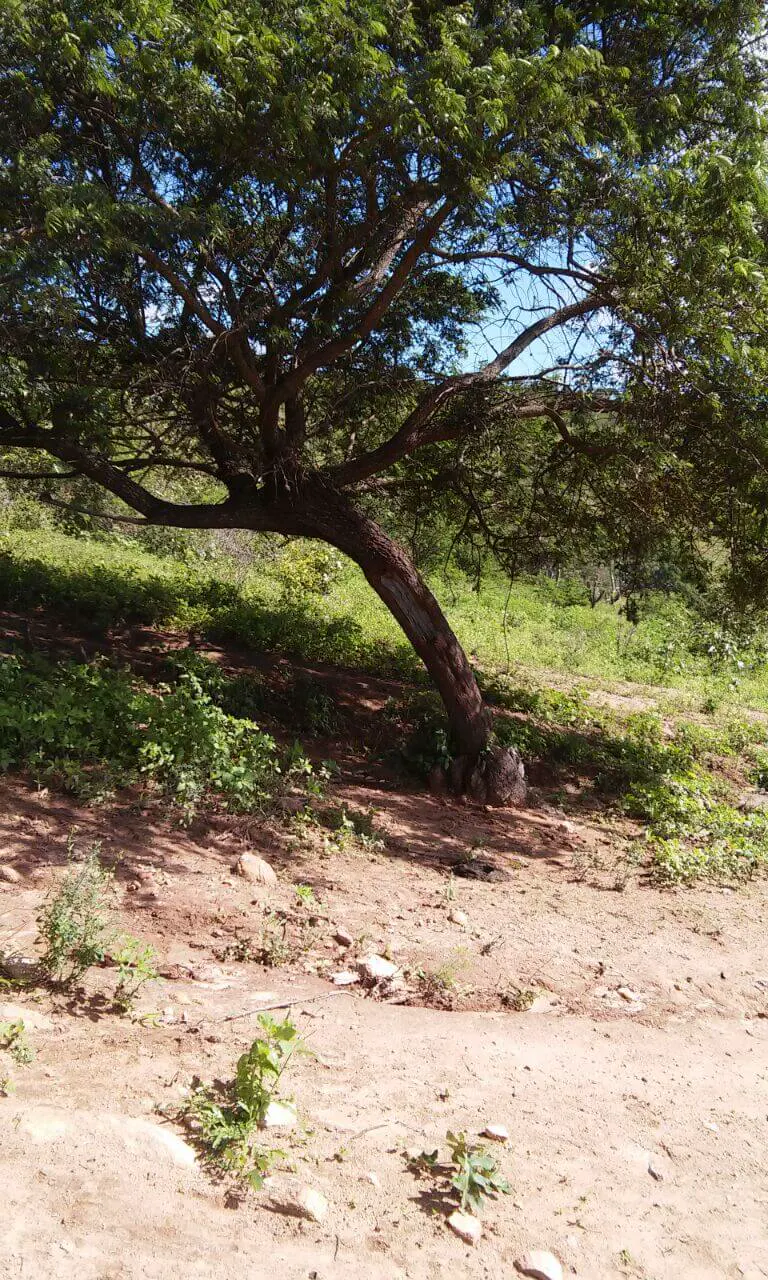
A Mimosa hostilis tree is Mimosa tenuiflora, a shrub or small tree usually 2 to 5 meters tall and sometimes up to 8 meters. It has fern-like leaves, scattered stem prickles, and dense flower spikes. It is native to northeastern Brazil and from southern Mexico to Venezuela, mostly in seasonally dry woodland.
Kew’s Plants of the World Online accepts the name Mimosa tenuiflora (Willd.) Poir. Mimosa hostilis is a synonym, which is why shops, including this one, still use it. The notes below are the plant itself: size, leaves, flowers, bark, and where it grows. How to germinate seed or keep a pot through a US winter belongs on the growing guide, not here.
Look at three things, then stop
If the plant is in front of you, you do not need the whole flora. Check the flower, the twigs, and the pod.
- The flowers are a short cylinder, not a round pink ball.
- The twigs usually carry short scattered prickles. A few twigs may have none.
- The pod is a small narrow bean, about the length of a finger joint, not a long flat pod in clusters.
A photo works the same way. Start with whichever of those three is actually in the frame. A crown of ferny leaves, with no flower and no pod, is not an identification. If all you have is a bag of bark, skip to the end of this page. The bag cannot show you the flower.
Quick facts
| Fact | Detail |
|---|---|
| Accepted name | Mimosa tenuiflora (Willd.) Poir. |
| Synonym still in trade | Mimosa hostilis (Mart.) Benth. |
| Family | Fabaceae, the legume family |
| Form | Shrub or small tree, sometimes scrambling |
| Height | Commonly 2–5 m (about 6–16 ft). Flora de Nicaragua gives 1–8 m (about 3–26 ft). |
| Leaves | Bipinnate, 5–10 pairs of pinnae, leaflets about 3–6 mm (about 1/8–1/4 in) |
| Flowers | Spikes about 3–8 cm (roughly 1–3 in) across the floras. Corolla pink to purple, stamens white, so the spike looks pale. |
| Stems | Often with scattered prickles 2–10 mm, sometimes unarmed |
| Native range | Northeastern Brazil, and southern Mexico to Venezuela |
| Habitat | Seasonally dry woodland and scrub, including the Caatinga |
How big a full-grown tree is
This is not a shade tree in the silk-tree sense. Botanical descriptions call it a shrub or a small tree. Barneby’s account, quoted on World Flora Online, says plants are commonly 2–5 m, with stiff, dark branches. The Flora de Nicaragua gives a wider band, 1–8 m. A full-grown plant can be a low, wide shrub or a short tree with a real trunk. It does not become the 15 m pink-flowered tree people in the United States mean by “mimosa.”
Young plants are a tangle of thin, fern-leaved stems. The trunk and the dark, knotty branches show up later. The photo below is a mature plant in open, dry ground: one leaning trunk, a broad crown of fine foliage, and no pink canopy.
Leaves
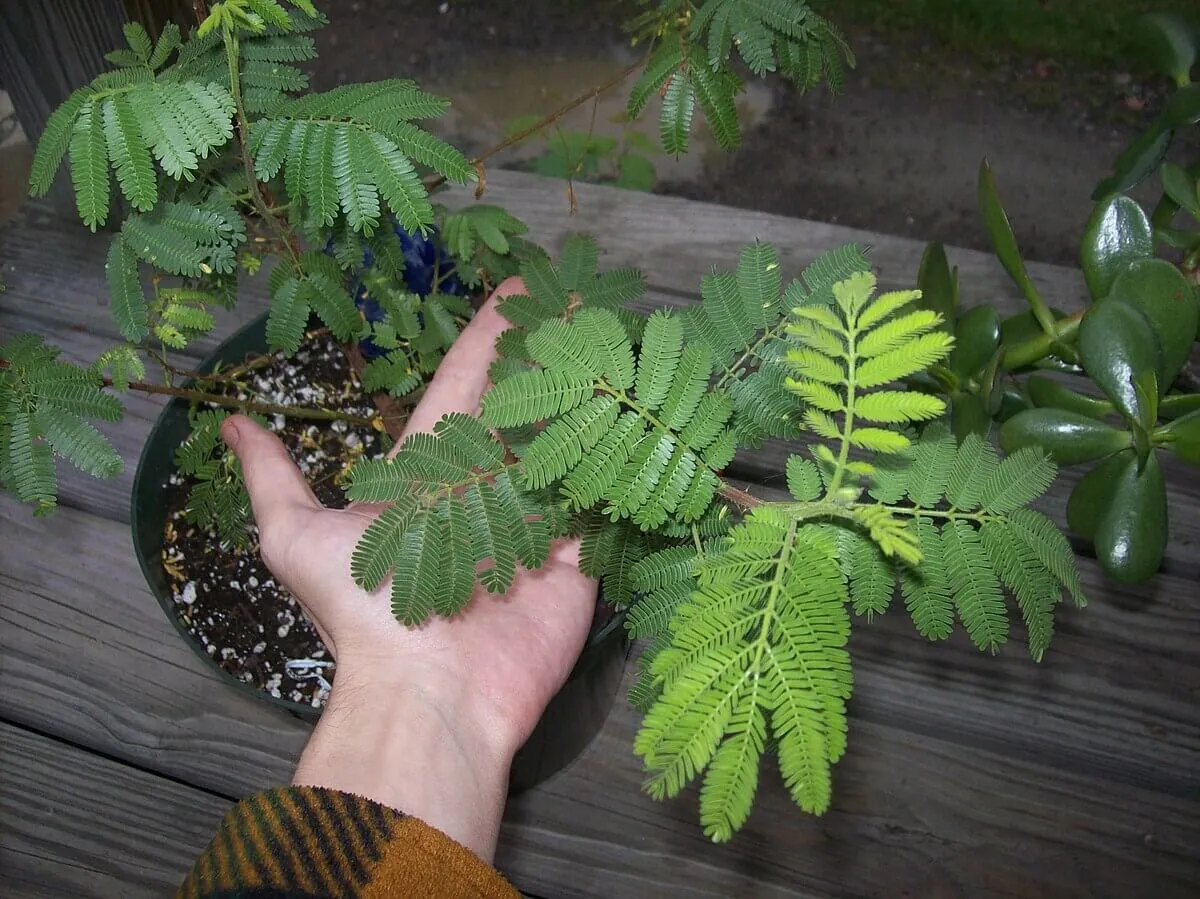
The leaf is bipinnate: a central stalk with paired side stalks, and each side stalk lined with many small leaflets. In the Nicaragua flora there are 5–10 pairs of pinnae, and each pinna carries about 10–30 pairs of leaflets. Those leaflets are narrow, about 3–6 mm long and under 2 mm wide. That is the fern-like look.
The same plan shows up on the Persian silk tree, which is why the English name “mimosa” jumped genera. Hostilis leaflets are the smaller ones. A leaf in the hand, next to a ruler, is a better check than a photo of a whole crown. The silk tree comparison puts the two leaves, flowers, and pods in one table.
Flowers and pods
The flower head is a spike, not a powder puff. Spikes are dense, axillary, and about 3–6.5 cm long. The corolla is pink to purple. The stamens are white, which is why a spike can look pale or whitish from a distance even though the petals are not white. It does not read as a pink pompom.
The fruit is a small legume. The Nicaragua flora describes a lance-shaped pod about 2–4.5 cm long and 5–7 mm wide, with 2–6 segments and a pointed tip. That is a short, narrow pod. A silk tree’s pod is a long flat bean, several times that length. If you only have a photo of the flowers, look for a cylinder of bloom rather than a round pink head.
Prickles, trunk, and why the root bark is the part people buy
Branches are often armed. The Flora de Nicaragua says prickles sit irregularly along the internodes, and that some stems are unarmed. Barneby describes stout prickles about 2–10 mm long on a swollen base. You should not need a microscope. On a typical woody stem they are obvious, and then absent on the next twig. “Always thorny” would be too strong. “Often prickly” matches the floras.
The trunk bark is the dark, rough coat on older wood. The material in a dye or soap studio is not that trunk bark. It is the inner bark of the root, the reddish fibrous layer under a thin outer coat. Why that layer is the one that carries the tannins, and how trunk bark differs from root bark, is the subject of the root bark anatomy guide. How the root is dried and milled into chips or powder is the path from tree to powder.
Young plant and full-grown tree
A seedling is mostly leaf. The bipinnate foliage is already the feature you notice, and the stem is still thin enough that a prickle, if it has formed, is easy to miss in a photo. By the time the plant is a few years old the wood darkens, the branches stiffen, and the prickles on older internodes are the thing you see before the flowers. A full-grown crown is a cloud of fine leaflets on a short trunk, often leaning, in open scrub rather than in a mowed lawn.
Use that sequence when you compare photos. A pot of ferny leaves is not yet showing the spike, the short pod, or the trunk. A mature silk tree is already showing the pink heads and the long pods. If a photo has neither flowers nor pods, say so, and do not treat the leaf as an identification.
Where it grows
Kew maps the species as native from southern Mexico to Venezuela and in northeastern Brazil, and also records it in parts of Central America and northern Colombia. Flora do Brasil confirms it across the Northeast, south to Minas Gerais. In Brazil it is a plant of the Caatinga, the seasonally dry woodland of the interior, and it also enters cerrado. The Nicaragua flora places it in deciduous forest, thorn scrub, and disturbed pine-oak woods, from roughly 25 m up to about 1,500 m.
That is a dry-season plant with a wide American range, not a wetland tree and not a temperate street tree. It will not behave like the silk tree that sails through a North Carolina winter. Frost hardiness, pots, and US growing conditions are outside this page. Use the growing guide linked above for that, and treat any nursery zone number you did not get from a flora as a claim to check.
Names by region
One short list is enough. Longer name history lives on the hostilis-versus-tenuiflora article linked above.
| Where | Name you will see |
|---|---|
| Trade and this shop | Mimosa hostilis, MHRB |
| Accepted botanical name | Mimosa tenuiflora |
| Brazil | Jurema, jurema preta |
| Mexico | Tepezcohuite, for the bark |
| United States, everyday speech | “Mimosa tree” usually means the silk tree, not this one |
Rainy season and dry season
The tree does not look the same in every month, which is why two honest descriptions can seem to disagree. Embrapa’s 2021 account of plants visited by bees describes Mimosa tenuiflora as deciduous in the dry season: a shrub or small tree 2–8 m tall, dark rough bark, reddish-brown branches, and sparse prickles. In the rains the crown fills with bipinnate leaves. In the dry months many plants drop those leaves, and what you see is the trunk and the armed twigs.
That same Embrapa account calls the flowers white and puts them in spikes 4–8 cm long. The Flora de Nicaragua puts the spikes at 3–6.5 cm and describes the corolla as pink to purple. Brazil’s flora records white filaments. Read them together. From a few steps away the spike looks white or cream, because the stamens are white and they are the part that sticks out. The petals underneath are not a pink powder puff. A page that says only “white flowers,” and a page that says only “pink flowers,” are each leaving half of the spike out.
Pods in the Nicaragua flora are about 2–4.5 cm long and only 5–7 mm wide. Embrapa simply calls them pods that open when ripe. Either description is a small fruit. It is not the long flat bean, 8–20 cm, that piles up under a silk tree.
From the crown down
Walk the plant in one direction so you do not talk yourself into a match.
Start at the crown. In the wet season it is a cloud of tiny leaflets on a short tree, often with more than one stem. In the dry season the crown may be thin or bare. Neither season produces a broad lawn-tree canopy of pink balls.
Move to a woody twig. Look for prickles a few millimetres long, scattered, not paired at every node like a rose. Then look at a second twig. If that one is smooth, you have not disproved the species. The floras allow both.
Then the leaf, if the plant still has any. A side stalk of tiny leaflets, each about 3–6 mm, is the ferny look. It is also the look of several other mimosas and acacias. The leaf supports the identification. It does not finish it.
Last, the ground and the roots. Small jointed pods may be on the plant or under it. The commercial material is not those pods and not the dark trunk bark. It is the inner bark of the root, reddish and fibrous once it is dried. That is why a standing tree and a bag of bark are related, and why a photo of one does not prove the other.
What a bag of bark cannot prove
Root bark is sold as chips, shreds, or powder. None of those forms still has a flower, a prickle, or a pod attached. Color and fibre tell you about the processing. They do not name the tree. The name on the label has to do that: Mimosa tenuiflora or its synonym Mimosa hostilis, or the regional names jurema and tepezcohuite for this same species.
A pink-flowered tree in a US yard is the usual reason people open this page. That tree is almost always the silk tree, and its roots are not this product. Use the three checks above when you have the living plant. Use the label when you have the bag.
What the bark is sold for
The root bark is a dye and tannin material: color on cloth, a tannin in soap, and a vegetable tannin for leather. Those are the uses this shop writes about. Chips, shredded bark, and powder, from a 100 g sample up to 10 kg, are listed on the root bark category. Orders ship inside the United States.
Frequently Asked Questions
Botanical descriptions put it at roughly 2–5 meters in the common case, and up to about 8 meters in the Flora de Nicaragua. It is a shrub or a short tree. It does not reach the size of a mature Persian silk tree, which the US Forest Service records at about 10–50 feet.
They are dense cylindrical spikes about 3–6.5 cm long, not round pink powder puffs. The corolla is pink to purple and the stamens are white, so a spike can look pale. If the bloom is a fragrant pink pompom, you are looking at Albizia julibrissin.
No. Floras describe scattered prickles along the internodes, about 2–10 mm long, and they also note stems with no prickles at all. Prickles are common. A smooth twig on an otherwise matching plant does not make it a silk tree.
Kew’s native range is southern Mexico to Venezuela and northeastern Brazil. In Brazil it is typical of the Caatinga and also occurs south to Minas Gerais. It grows in seasonally dry woodland and thorn scrub, including sites from near sea level to around 1,500 m.
No. The front-yard mimosa is Albizia julibrissin, the Persian silk tree, with pink powder-puff flowers and long flat pods. Mimosa hostilis is Mimosa tenuiflora, a shorter, often prickly tree of dry woodland in Brazil and Mexico. The leaf shape is similar enough to cause the nickname, and the flowers are not.