
Library
Mimosa Hostilis vs Mimosa Pudica: A Comparative Guide
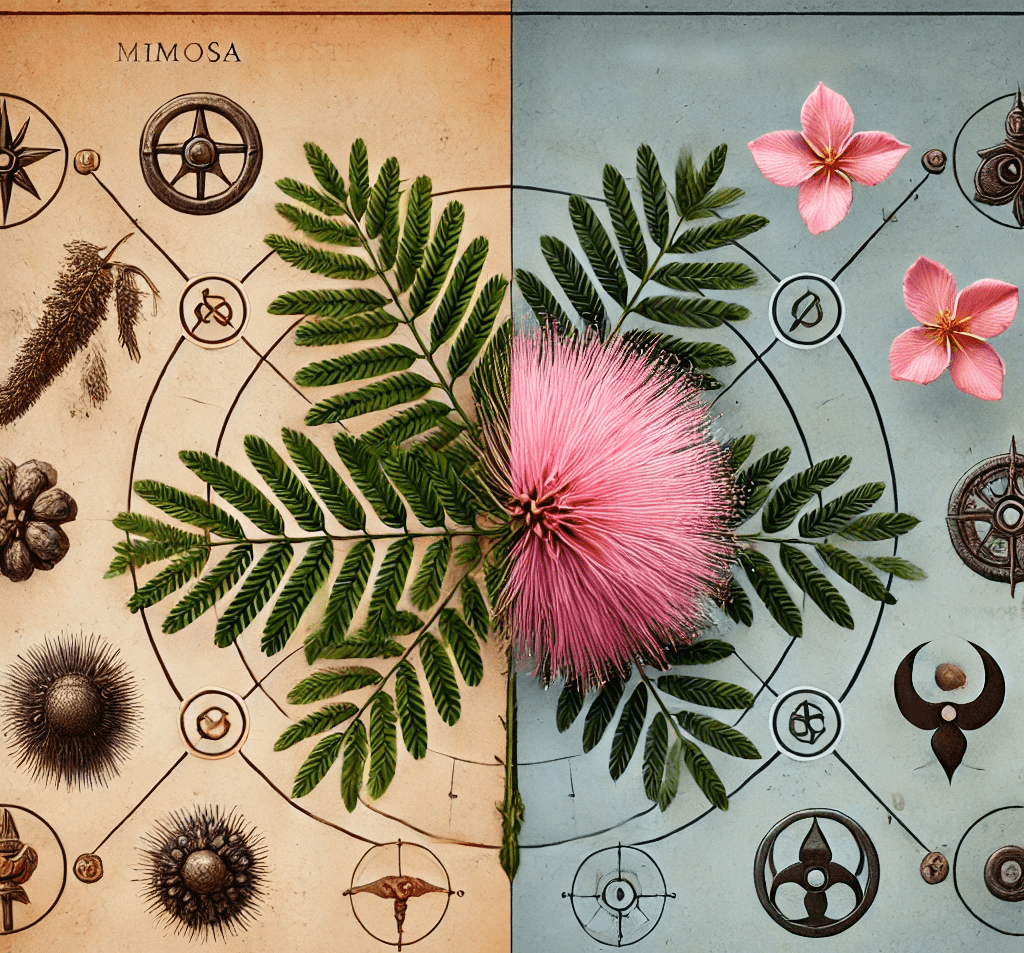
The genus Mimosa contains several hundred species, but two in particular attract disproportionate attention for very different reasons: Mimosa hostilis (now more accurately classified as Mimosa tenuiflora), prized for its bark chemistry and use in traditional medicine and natural dyeing, and Mimosa pudica, the “sensitive plant” beloved for its instant, touch-triggered leaf movement. Though they share a genus, their botany, chemistry, and uses diverge sharply.
Botanical Profiles
Mimosa tenuiflora (Hostilis) is a woody, thorny perennial shrub or small tree native to northeastern Brazil’s Caatinga biome and parts of southern Mexico, where it is known locally as jurema preta or tepezcohuite. It can reach 6–8 meters, with bipinnate, fern-like leaflets and small white or pale-pink pom-pom flowers. Its most commercially and scientifically significant feature is its root bark — dense, dark brown, and unusually rich in tannins.
Mimosa pudica, by contrast, is a low, creeping herbaceous plant rarely exceeding half a meter in height, native to Central and South America but now naturalized across the tropics and subtropics worldwide. Its defining trait is thigmonasty — the rapid folding of its compound leaves in response to touch, heat, or shaking, a defense mechanism thought to startle herbivores or reduce leaf surface area exposed to damage. It produces small puffball-like pink or lavender flowers and, unlike M. tenuiflora, has minimal thorn development.
Chemistry: What the Research Shows
Phytochemical analysis is where the two species diverge most clearly, and this is an area with a meaningful body of peer-reviewed research behind it.
M. tenuiflora root bark has been repeatedly documented as containing high levels of condensed tannins, with pharmacognostical work reporting tannin content around 16% of the genuine dried bark, composed largely of proanthocyanidins. This tannin and saponin content has been identified as the plant’s main biologically active component, underlying its long history of use in treating skin burns and lesions. Separately, phytochemical fractionation studies of the root bark have identified meaningful concentrations of flavonoids, positioning the species as a candidate source of bioactive compounds for further pharmacological research, including preliminary work on acetylcholinesterase inhibition relevant to neurodegenerative disease study.
Mimosa pudica, in contrast, has a distinct chemical profile: alkaloids (including the non-protein amino acid mimosine), flavonoids, tannins, saponins, terpenoids, and glycosides. Review literature compiling pharmacological studies on the species credits these compounds with a range of tested biological activities, discussed below.
Traditional and Ethnobotanical Uses
M. tenuiflora bark has a long documented history in Mesoamerican and Brazilian folk medicine as a topical treatment for burns, wounds, and skin lesions, a use that has since attracted formal clinical interest. Extracts derived from the bark have been the subject of clinical trials examining phytodrugs for treating venous leg ulcerations, building on generations of traditional cicatrizing (wound-healing) use. The plant also holds broader cultural significance in parts of northeastern Brazil and southern Mexico, where it is woven into regional folk practice and craft traditions.
Mimosa pudica carries an equally rich traditional medicine profile. In Ayurvedic and Unani systems of medicine, preparations from its roots, leaves, and seeds have historically been used for wound care, diarrhea, dysentery, hemorrhoids, insomnia, and gynecological complaints. Modern pharmacological screening has tested many of these folk applications directly: controlled animal studies using carrageenan-induced paw edema models have found that ethanolic and aqueous leaf extracts produce measurable, dose-dependent anti-inflammatory effects comparable in direction (if not magnitude) to standard anti-inflammatory drugs, lending some experimental support to the plant’s use in traditional pain and swelling remedies. Other studies in the same review literature report antimicrobial, antioxidant, antidiabetic, and hepatoprotective effects in animal models, though most authors are careful to note that human clinical trials remain limited.
Ecological Roles
Both species contribute meaningfully to their ecosystems, though in different ways. As legumes, both fix atmospheric nitrogen through root-nodule bacteria, improving soil fertility wherever they grow — a trait M. tenuiflora shares with many Fabaceae trees used in reforestation and erosion control in degraded Caatinga landscapes. M. tenuiflora additionally supports pollinators as a forage source for bees, particularly valuable during dry seasons when floral resources are scarce, and its dense, tannin-rich wood is prized locally for fence posts, charcoal, and construction because the tannins resist rot. Mimosa pudica, being a low groundcover that thrives in poor, disturbed soils, is often one of the first colonizers of degraded land and roadside verges, and its nitrogen-fixing capacity has made it useful in some small-scale soil-improvement and phytoremediation contexts.
Modern Commercial and Research Applications
Beyond traditional medicine, M. tenuiflora bark has become a significant commercial commodity. Its high tannin content makes it a popular natural dye for textiles and leather, yielding deep reds, purples, and browns depending on the mordant used, and bark extracts are formulated into skincare products marketed for their regenerative, astringent properties. The species also remains a subject of active phytochemical and pharmacognostic research focused on standardizing its tannin and flavonoid content for quality control and potential wound-care product development.
Mimosa pudica has taken a different commercial path — it is grown worldwide as a novelty ornamental and educational plant precisely because of its touch response, making it a staple in botany classrooms demonstrating rapid plant movement (nastic response) and electrical/chemical signaling in plants. Researchers have also used it as a model organism for studying plant memory and habituation, since repeated non-threatening stimulation causes the plant to “learn” to stop folding — a phenomenon documented in plant-behavior literature. Pharmaceutically, it continues to be screened as a low-toxicity source of anti-inflammatory and antioxidant compounds for potential drug development.
Key Differences at a Glance
| Feature | Mimosa Hostilis (M. tenuiflora) | Mimosa Pudica |
|---|---|---|
| Growth form | Thorny shrub/tree, up to 8m | Creeping herb, under 0.5m |
| Native range | NE Brazil, S. Mexico | Central/South America (now pantropical) |
| Signature trait | Tannin-rich bark | Rapid touch-triggered leaf folding |
| Primary traditional use | Wound and burn healing | Digestive, anti-inflammatory folk remedies |
| Key research focus | Tannin chemistry, wound healing | Anti-inflammatory, antioxidant, antidiabetic screening |
| Commercial use | Natural dye, skincare, cordage/fuel wood | Ornamental, educational, phytoremediation |
Conclusion
Despite their shared genus, Mimosa hostilis and Mimosa pudica occupy almost entirely separate ecological, chemical, and cultural niches. M. tenuiflora stands out for a bark chemistry — rich in tannins and saponins — that has attracted both traditional healers and modern researchers interested in wound care and natural dyeing. M. pudica, meanwhile, is defined less by bark chemistry and more by a striking, well-studied behavioral trait, paired with a research-supported profile of anti-inflammatory and antioxidant activity. Understanding these distinctions matters both botanically and practically — the two plants are sometimes confused by name alone, but they serve very different purposes.