Artisans have simmered Mimosa tenuiflora bark in pots for centuries — steeping it for textile baths, pouring it into leather tanning vats, rubbing it into wounds as traditional medicine across rural Mexico and Brazil. The bark’s pigment, a dense reddish-purple loaded with 16% tannins, is one of the most color-rich botanical materials on the planet. And yet, if you search the world of natural printmaking, you will not find a single established recipe, workshop, or published experiment specifically dedicated to using Mimosa tenuiflora as a block printing ink.
That gap is strange. It is also an open invitation.
This article maps exactly why that gap exists, what the chemistry tells us about the plant’s genuine printing potential, and how to start bridging the distance between dye bath and carved woodblock — in practical, step-by-step terms.
What Mimosa Tenuiflora Actually Is (And Why It Matters to Printers)
Mimosa tenuiflora — also widely known as Mimosa hostilis, Jurema Preta, or tepezcohuite — is a perennial tree native to northeastern Brazil and southern Mexico. The part most relevant to colorwork is the inner root bark, not the leaves or flowers. That bark holds an exceptionally dense concentration of condensed tannins, flavonoids, saponins, and polyphenols, with a total tannin count of approximately 16% by dry weight. For context, oak gall ink — the ink that scribes used for illuminated manuscripts and that writers used until the 19th century — is built on an iron-tannin reaction using tannin concentrations far lower than what Mimosa tenuiflora naturally contains.
The chromatic range is significant. Depending on the mordant used and the pH of the extraction medium, Mimosa tenuiflora can yield:
- Deep reddish-purple to burgundy tones in a neutral pH bath
- Warm brown and mahogany tones with iron mordants
- Softer mauves and dusty pinks in an alkaline solution
- Near-black in a high-iron, low-pH reaction
This variability is not a weakness. For a printmaker, it is the entire point.
Why the Dye Bath Hasn’t Become a Printing Ink
The artisan natural dyeing world has known about Mimosa tenuiflora for years. It appears in sustainable fashion studios, eco-conscious soap workshops, and botanical craft communities. So why has no one turned it into a block printing ink at scale?
Three structural reasons explain this:
1. The dye community and the printmaking community rarely overlap. Natural dyers work with fabric, fiber, and mordants. Printmakers work with carved blocks, viscosity, and paper. The material knowledge does not travel easily between these two groups, even though the underlying chemistry is directly compatible.
2. Bark extraction is perceived as slow. Unlike flower or berry inks that yield color within minutes of simmering, bark requires 1–2 hours of low, sustained heat to release its full pigment load. This creates a friction point for printmakers accustomed to ready-mixed, off-the-shelf inks. The effort is not actually prohibitive — it is simply unfamiliar in a printmaking context.
3. The concentration step is missing from existing recipes. Most natural fabric printing ink guides recommend reducing the dye extract to a thick, syrupy consistency before printing. This concentration step is critical for achieving the opacity, body, and adhesion needed to transfer a clean image from block to paper or cloth. Guides for Mimosa tenuiflora consistently describe it as a dye bath — the concentration phase, binder incorporation, and viscosity targeting needed for actual printing have not been formally worked out and documented.
The Chemistry Works in the Ink’s Favor
Understanding why Mimosa tenuiflora is chemically well-suited to printing inks matters before picking up a pot.
Tannins as natural mordants and binders. The same tannin content that makes the bark useful in leather production also gives it a strong affinity for natural fibers and paper. Tannins form covalent and hydrogen bonds with cellulose-based substrates. This means a Mimosa tenuiflora ink applied to cotton rag paper or unbleached linen has a built-in adhesion mechanism that synthetic dye inks cannot replicate without chemical mordanting.
Polyphenol oxidation builds depth over time. When exposed to air and light, polyphenol-rich inks darken and deepen — similar to walnut hull ink, one of the most respected traditional printmaking inks. A fresh Mimosa tenuiflora print may appear a warm reddish-brown; after a week of exposure, the oxidation brings out the darker mahogany and near-black tones. Printmakers who understand this can plan for it, using the oxidation curve as part of the work’s visual effect.
The iron-tannin reaction is fully accessible. Block printing on pre-tannined fabric with an iron mordant was a core technique in traditional Indian textile printing. Mimosa tenuiflora, with its 16% tannin content, is an exceptionally strong tannin source for this application. A fabric pre-soaked in an iron solution and then block-printed with a Mimosa tenuiflora extract should produce a deep, near-black impression with high colorfastness — a property that most botanical inks struggle to achieve.
Gum arabic and plant starch binders are compatible. Water-based natural inks require a binder to give them body and to control spread on the printing surface. Gum arabic — the hardened sap of the Acacia tree — is the most common natural binder for water-based printmaking inks and is chemically compatible with tannin-rich extracts. Plant starch (rice starch or tapioca) works as an alternative for fabric printing applications and gives a slightly softer impression.
The Gap in the Market — And Why It Matters Now
The eco-friendly ink market was valued at approximately USD 4.2 billion in 2025 and is projected to reach USD 8.9 billion by 2035, growing at a CAGR of 7.8%. More than 65% of companies are now actively adopting sustainable inks to reduce their environmental footprint. Over 60% of textile printers already rely on biodegradable, water-based inks for production.
Yet the bio-based ink conversation remains dominated by soy oil, algae, and sunflower oil formulations — industrial-scale solutions for packaging and commercial printing. The artisan and craft printing market, which is expanding alongside the broader handmade goods movement, has almost no established botanical ink beyond walnut, indigo, and iron-gall formulations developed centuries ago.
Mimosa tenuiflora represents something neither of those tracks has addressed: a plant with documented, high-intensity pigment output, traditional provenance, ethical sourcing infrastructure (Mexican and Brazilian artisan producers already harvest and process it), and a chemistry profile that maps directly onto existing natural printmaking ink frameworks.
The reason nobody has formally documented it as a printing ink is not that it doesn’t work. It is that nobody has sat down to work it out yet.
A Starting Framework: Turning the Dye Bath Into a Printing Ink
The following approach draws on established natural ink-making principles applied to Mimosa tenuiflora’s specific chemistry. This is not a single fixed recipe — natural dyes, by their nature, vary with bark source, water mineral content, and extraction time. Treat this as a structured starting point for your own experimental practice.
Step 1: Extraction
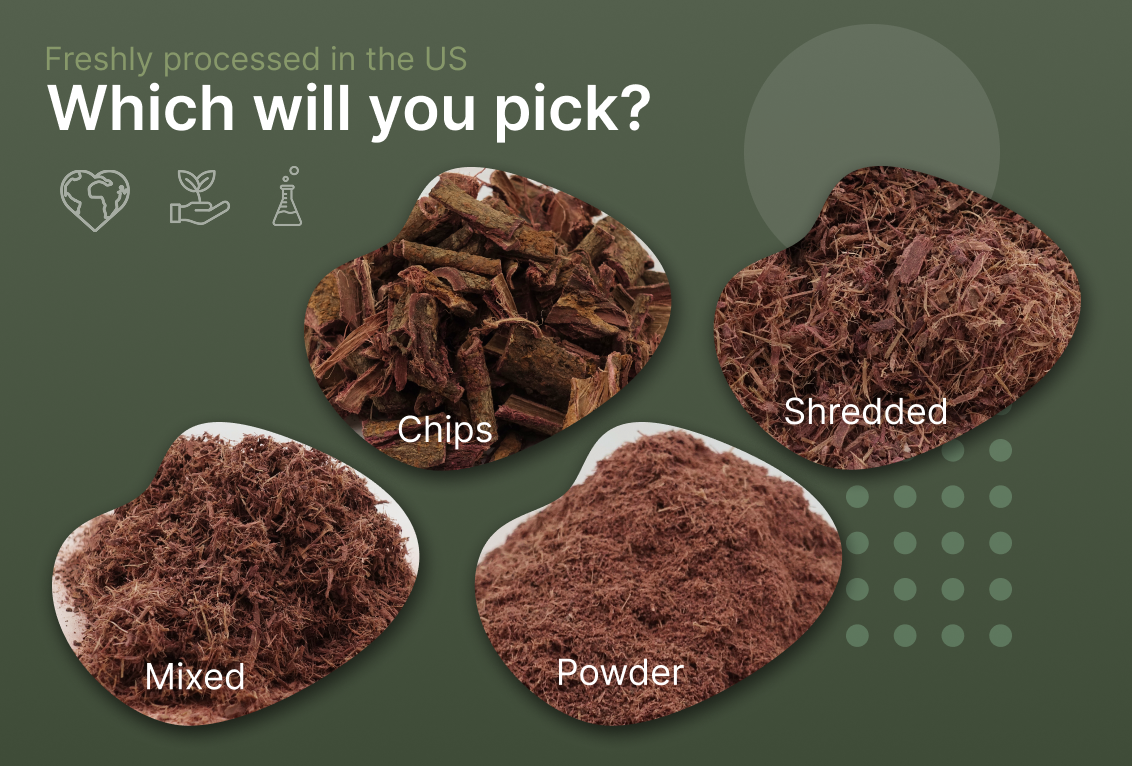
Simmer Mimosa tenuiflora root bark (shredded or powdered) in water at a ratio of approximately 1 part bark to 10 parts water by weight. Maintain a low simmer — not a rolling boil — for 1.5 to 2 hours. Powdered bark releases pigment faster than shredded; shredded bark gives a slightly more complex color profile. Strain through a fine cloth or coffee filter to remove all solids. The resulting liquid should be a deep reddish-brown.
Step 2: Concentration
This is the step missing from almost every existing Mimosa tenuiflora dye guide, and it is the step that makes the difference between a dye bath and a printing ink. Return the strained liquid to the pot and continue simmering, uncovered, until the volume reduces to approximately one-third of its post-extraction volume. The liquid will darken significantly and begin to coat the back of a spoon. The consistency should be similar to a thin syrup — fluid enough to load onto a block, viscous enough not to bleed immediately on contact with paper.
Step 3: Binder Addition
For paper and printmaking applications: dissolve gum arabic in a small amount of warm water (ratio: approximately 1 teaspoon gum arabic crystals to 60ml water) and stir gradually into the cooled, concentrated extract. The gum arabic increases body, controls spread, and improves adhesion. Begin with a small addition and assess viscosity before adding more.
For fabric printing applications: use cooked rice starch or tapioca starch as an alternative to gum arabic. Starch binders give a slightly stiffer impression with better colorfastness on cotton and linen substrates.
Step 4: pH Adjustment for Color Modulation
This is where Mimosa tenuiflora’s versatility becomes practically useful. Adding a small amount of white vinegar (acid, lowering pH) shifts the color toward warmer red-brown tones. Adding a small amount of washing soda or baking soda solution (alkali, raising pH) shifts toward softer mauve and grey-brown tones. Test on a small quantity first. The change is immediate and visually striking.
Step 5: Iron Modifier for Deep Tones
For maximum depth and colorfastness, particularly on fabric, prepare a simple iron modifier: dissolve a small amount of ferrous sulfate in water, or make a rusty water solution by soaking steel wool in vinegar for several days. Add a very small quantity — a few drops to a tablespoon — to your concentrated extract. The iron reacts with the tannins in the Mimosa tenuiflora to produce a much darker, near-black tone. This iron-tannin reaction is the same chemistry underlying traditional iron gall ink and traditional Indian block printing with tannin mordants.
Step 6: Block Selection and Application
Carved wooden blocks work well for water-based botanical inks. Rubber or linoleum blocks are less porous and may require a slightly thicker ink consistency. Load the ink onto the block using a soft brush or sponge applicator rather than a brayer, which tends to deposit botanical inks unevenly. Press firmly and evenly. Test your pressure on scrap paper before printing your final surface.
For fabric printing: pre-soak fabric in a cold alum mordant bath (aluminum sulfate dissolved in water) and allow to dry fully before printing. The alum pre-treatment significantly improves the bonding of tannin-rich inks to natural fibers.
What to Expect: The Properties of a Mimosa Tenuiflora Print
Color on arrival: Reddish-brown to warm burgundy, depending on extraction depth and pH.
Color over time: Polyphenol oxidation will deepen the print over days and weeks. Plan for this. A light initial impression can become significantly darker after exposure to air and UV.
Lightfastness: Moderate to good for a botanical ink, particularly when an iron modifier is used. Better on paper than on fabric without mordanting. Equivalent to walnut hull ink and significantly better than most flower-based botanical inks.
Bleed characteristics: Well-controlled with gum arabic binder and adequate concentration. The high tannin content gives the ink some natural body even before binder addition.
On fabric vs. paper: Paper results are immediate and high-contrast. Fabric results benefit substantially from pre-mordanting and may require heat-setting (a hot iron applied over baking paper) to improve wash fastness.
The smell: Worth noting for anyone planning an extended printing session. The bark extract has a earthy, slightly astringent botanical scent that some people find pleasant and others do not. It dissipates as the print dries.
Ethical Sourcing: What Responsible Use Looks Like
Mimosa tenuiflora has cultural and ecological significance in the regions where it grows. It is traditionally used in indigenous medicine and ceremony in northeastern Brazil and southern Mexico. Responsible sourcing matters here — not just as an ethical position but as a practical quality consideration, since bark harvested without care for plant health produces inconsistent pigment.
When sourcing Mimosa tenuiflora for printmaking:
- Choose suppliers who work with established Mexican or Brazilian artisan producers who practice sustainable wild harvesting or cultivation
- Prefer root bark that is clearly described as sourced without whole-tree removal
- Use powdered or shredded bark from suppliers who can describe their sourcing chain
- Start with small quantities to test pigment quality before committing to bulk purchasing
The existing market for Mimosa tenuiflora as a natural dye material means that ethical sourcing infrastructure already exists — you are not creating demand from scratch but redirecting existing supply toward a new application.
Why This Matters for the Future of Natural Printmaking
The natural printmaking revival is real and growing. Botanical ink workshops sell out months in advance. Sustainable fiber arts communities are expanding rapidly across Europe, North America, and South Asia. The question most artisans in this space are asking is not whether to use natural materials, but which natural materials have genuine printing merit beyond the well-trodden indigo-and-walnut track.
Mimosa tenuiflora answers that question with a strong chemical argument: high tannin content for natural mordanting, polyphenol depth for oxidative darkening, wide pH-responsive color range for creative control, and existing ethical sourcing infrastructure.
The only thing it lacks is documentation. The workshop guides, published recipes, tested results, and shared community knowledge that have built walnut hull ink and indigo printing into established practices have not yet been written for Mimosa tenuiflora.
This article is a start. The next step belongs to whoever picks up a block and begins.
Frequently Asked Questions
Can I use Mimosa tenuiflora bark powder directly without simmering?
A cold infusion or alcohol extraction will release some pigment but will not achieve the same depth as a hot water extraction. For printing applications where concentration and pigment density matter most, hot extraction followed by reduction is the recommended approach.
Is Mimosa tenuiflora ink archival?
No botanical ink is fully archival in the way modern synthetic inks are. However, tannin-based inks have better longevity than most botanical inks — iron gall ink manuscripts from the medieval period survive in readable condition today. With gum arabic binder, storage away from direct light, and good quality paper, Mimosa tenuiflora prints should perform well over time.
Can I combine it with indigo for a wider color range?
Yes, and this is a genuinely interesting experimental direction. Indigo provides the blue range that Mimosa tenuiflora does not. Layering prints — using Mimosa tenuiflora first and indigo over the top, or vice versa — can produce complex, multi-tonal results.
Does it work on synthetic fabrics?
No. Like all tannin-based botanical inks, Mimosa tenuiflora has minimal affinity for synthetic fibers such as polyester or nylon. It is designed by its chemistry to bond with natural fibers: cotton, linen, wool, silk, and paper (which is cellulose-based).
Is it safe to handle?
Yes, at the concentrations used for printing. Mimosa tenuiflora bark extract has a long history of topical use in traditional medicine. Standard sensible practices apply: wear gloves if you have sensitive skin or are working with an iron modifier, work in a ventilated space, and keep the extract away from eyes.
Summary: The Case for Mimosa Tenuiflora Block Printing Ink
| Property | Performance |
|---|---|
| Tannin content | 16% (among the highest of any dye plant) |
| Color range | Reddish-purple → mahogany → near-black (mordant-dependent) |
| Binder compatibility | Excellent with gum arabic and plant starch |
| Substrate range | Cotton, linen, silk, wool, rag paper |
| Sourcing | Established artisan supply chains in Mexico and Brazil |
| Printmaking documentation | Almost none — a wide open field |
The bath has been ready for a long time. The block is waiting.