
Library
Why Root Bark Is the Most Studied Part of Mimosa Hostilis?
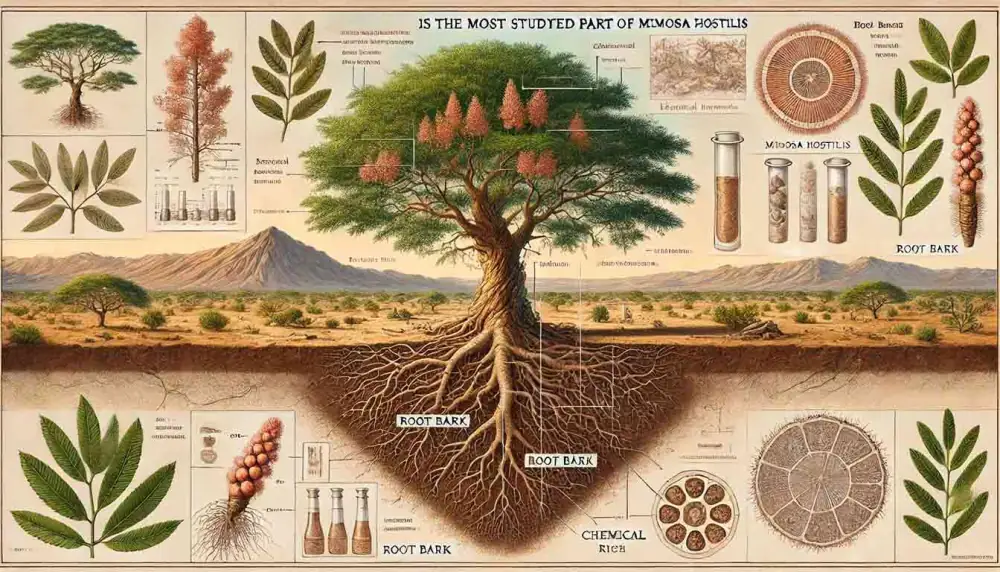
Mimosa hostilis, better known botanically as Mimosa tenuiflora and locally as jurema preta or tepescohuite, has one part that dominates the scientific literature: the root bark. Search PubMed, Scielo, or any botanical database for this species and the overwhelming majority of phytochemical and pharmacological papers trace back to bark harvested from the root and lower trunk, not the leaves, flowers, or seeds.
That pattern is not an accident of sampling convenience. It reflects where the plant concentrates its most biologically active compounds, and where centuries of traditional use pointed researchers first. This article walks through the actual peer-reviewed evidence: what the root bark contains, why it became the plant’s primary research target, what wound-healing and dye-industry studies have found, and what the current science does and doesn’t support.
Why Root Bark Specifically Draws Research Attention
Roots concentrate a plant’s defensive chemistry
In most woody legumes, secondary metabolites like tannins, saponins, and phenolic compounds accumulate more heavily in root and root-bark tissue than in leaves or flowers. Roots are a plant’s most exposed and least replaceable organ underground, under constant pressure from soil pathogens, fungi, and burrowing insects, so they tend to invest more heavily in chemical defenses. A phytochemical study of M. tenuiflora root bark, conducted at a Brazilian university, noted explicitly that this tissue had barely been characterized in the literature despite the trunk bark already being well documented, and its results confirmed that the root bark carried its own distinct profile of phenolic and flavonoid compounds not previously reported for the species.
Centuries of traditional use pointed here first
Long before laboratory analysis existed, indigenous and rural communities across Bahia state in Brazil and across southern Mexico were already selecting root and lower-trunk bark for medicinal preparations. Ethnopharmacological surveys describe residents of Contendas do Sincorá, Bahia, drying and grinding this bark to treat coughs and skin wounds, and Mexican ethnobotanical records describe the same material, called tepescohuite, being powdered and applied directly to burns. When modern researchers set out to validate traditional remedies, they followed the same sourcing the communities already trusted, which is why the bark, rather than the leaf or flower, became the default research material.
It is the commercially harvested part
Because root bark is also the material most widely sold and traded, from dye suppliers to herbal medicine vendors, it is the most accessible standardized raw material for laboratories to source in bulk. That commercial availability reinforces the research bias toward the root bark rather than harder-to-obtain flower or seed tissue.
The Phytochemical Profile of the Root Bark
Multiple independent phytochemical analyses of M. tenuiflora bark converge on a similar chemical fingerprint, though exact concentrations vary by region, harvest season, and extraction method.
Tannins. Condensed tannins are the single most abundant and most studied class of compound in the bark. A Brazilian bromatological and microbiological analysis measured tannin and phenolic content directly in bark powder from jurema preta and a related species, confirming tannins as a dominant fraction alongside saponins. A separate study quantified the condensed-tannin content of M. tenuiflora bark extract used in clinical wound treatment at 1.8%, standardized specifically because tannin concentration was considered the active benchmark for the extract’s cicatrizing (wound-closing) effect.
Saponins. Multiple qualitative phytochemical screenings of the bark, including comparative work on M. tenuiflora and the related Mimosa pudica, identify saponins as a consistently present secondary metabolite class in the bark extracts, alongside alkaloids and tannins.
Flavonoids. Isolated flavonoid compounds from the bark include sakuranetin and its methylated relative isosakuranetin, along with the chalcones kukulkanin A and B, first identified from M. tenuiflora bark by Domínguez and colleagues. A pharmacological study later confirmed that sakuranetin isolated from the bark extract reduced inflammatory pain responses in animal models, giving one of the flavonoid fractions a direct, tested biological effect.
Arabinogalactans and polysaccharides. High-molecular-weight polysaccharides called arabinogalactans, isolated from bark extract, were shown in an in vitro study published in Journal of Ethnopharmacology to significantly stimulate the proliferation of human dermal fibroblasts, the skin cells responsible for producing new connective tissue during wound closure, providing a mechanistic explanation for why the bark has long been applied to wounds.
Alkaloids. As with many Mimosa species, the bark also contains alkaloid compounds; the literature identifies N,N-dimethyltryptamine (DMT) as the tryptamine alkaloid responsible for the plant’s psychoactive reputation, alongside other labdane diterpenoids and flavonoids reported for the species. This alkaloid content is a documented fact of the plant’s chemistry and is one reason M. tenuiflora material is legally restricted or controlled in a number of countries; this article does not cover extraction, preparation, or use of that alkaloid, and readers should treat any such use as a distinct legal and safety question governed entirely by their local jurisdiction.
Dermatological and Wound-Healing Research
The single largest body of peer-reviewed work on M. tenuiflora root and trunk bark concerns skin repair, and it is worth walking through because it is the best-controlled research the plant has.
A randomized, double-blind, placebo-controlled clinical trial tested a hydrogel containing a 5% standardized bark extract on ambulatory patients with venous leg ulcers, a chronic and difficult-to-treat wound type. The bark-extract hydrogel group showed improved ulcer healing compared with the group receiving the same hydrogel base without the extract, supporting the traditional Mexican ethnobotanical use of powdered tepescohuite bark on burns and skin lesions.
Laboratory work has since tried to explain that clinical result at the cellular level. The arabinogalactan study referenced above found that ethanol-precipitated compounds isolated from the bark’s water extract significantly increased mitochondrial activity and cell proliferation in human dermal fibroblasts, while having only a minor effect on keratinocytes, the outer skin cells. That distinction matters clinically, since fibroblast activity drives the formation of new connective tissue and closure of deeper wounds, which lines up with the bark’s traditional reputation for burns and ulcers specifically, rather than superficial abrasions.
A separate Brazilian study on the ethanolic extract and its solvent fractions found measurable antinociceptive (pain-reducing) and anti-inflammatory activity in animal models, and traced part of that effect to the isolated flavonoid sakuranetin, giving researchers a specific molecule, not just a crude extract, to credit for the traditional anti-inflammatory use of the bark.
Another polysaccharide-focused study found that an extracted polysaccharide fraction from the bark stimulated an acute inflammatory response via nitric oxide signaling in vivo, a finding the authors connect to the plant’s known role in early-stage wound healing, where a controlled inflammatory response is a necessary first step before tissue repair begins.
Antimicrobial and Antioxidant Studies
Because open wounds are vulnerable to infection, several studies have tested the bark extract directly against bacteria. One investigation found that both the crude ethanolic bark extract and its isolated tannins showed strong antibacterial activity against Staphylococcus aureus, Pseudomonas aeruginosa, and Escherichia coli, with minimum inhibitory concentrations (MIC) ranging from 62.5 to 250 micrograms per milliliter, a fairly potent range for a plant-derived crude extract. The same study also tested the extract’s effect on red blood cells and found it did not cause hemolysis and instead showed protective, antioxidant behavior, along with no mutagenic activity in bacterial or mouse-cell assays, an important safety signal for a compound with a long history of topical folk use.
A separate phytochemical and microbiological comparison of jurema preta and a related species similarly confirmed antimicrobial activity tied to the bark’s tannin and saponin content, reinforcing that the same tannin-rich chemistry responsible for the plant’s traditional dye use also appears to be doing double duty as a natural antimicrobial barrier on treated wounds.
Traditional and Industrial Dye Use
Outside of medicine, the same tannin concentration that makes the root bark pharmacologically interesting also makes it commercially valuable as a natural dye and tanning agent. Published textile research has tested M. tenuiflora bark extract as a dye for both plain and indigo-dyed cotton fabric, documenting the shade range and colorfastness the tannin-rich extract produces. That dual identity, a dye-industry raw material and a pharmacological research subject, is part of why the root bark specifically, rather than other plant parts, has an established global supply chain that keeps sample material flowing into laboratories.
Cognitive and Enzyme-Inhibition Research
A more recent line of investigation has looked at the root bark specifically, as distinct from trunk bark, for its potential relevance to neurodegenerative disease research. A dedicated phytochemical study of Mimosa tenuiflora root bark, noting that this specific tissue had almost no prior literature on its phenolic composition, isolated and characterized flavonoid and phenolic compounds using column chromatography and NMR spectroscopy. The same extracts were tested for acetylcholinesterase-inhibiting activity, the same enzyme targeted by several Alzheimer’s medications, and the crude and ethyl acetate root-bark extracts showed inhibition rates of 89% and roughly 94% respectively, results the authors describe as classifying the species as a potent natural inhibitor worth further pharmacological investigation.
Legal and Safety Considerations
Because M. tenuiflora bark contains the naturally occurring alkaloid DMT, its legal status is not uniform. In some countries the bark itself is unregulated and sold openly for dye, tanning, and cosmetic use; in others, any part of the plant containing DMT is treated as a controlled substance regardless of the stated purpose of sale. Regulatory status can also depend on the specific preparation or extract rather than the raw bark itself. Anyone sourcing the bark for craft, textile, or research purposes should verify current law in their own country and region before purchasing or importing it, since enforcement and classification vary and can change. This article is limited to summarizing published dermatological, phytochemical, and textile research; it is not medical advice, and it does not address extraction, preparation, or use of any controlled alkaloid.
Sustainability and Sourcing
Wild-harvesting root bark is inherently more destructive to a tree than harvesting leaves or seed pods, since removing root bark can kill or severely damage the plant. As commercial demand for both dye and research-grade material has grown, some suppliers in Brazil and Mexico have shifted toward managed or plantation-style harvesting rather than wild stripping, though the practice is not yet standardized industry-wide. Buyers focused on sustainability should ask suppliers directly about sourcing region and harvest method, since this information is rarely volunteered on product listings.
Research Gaps and Future Directions
Despite the volume of published work, researchers who study M. tenuiflora root bark are consistent about one limitation: much of the literature relies on crude or partially fractionated extracts rather than fully isolated, single-compound testing. The root-bark-specific phytochemical study that identified strong acetylcholinesterase inhibition, for instance, explicitly noted that no prior records existed on the phenolic constituents of root bark specifically, as opposed to trunk bark, meaning the two tissues had been treated as interchangeable in earlier work despite likely chemical differences. That gap matters for anyone trying to compare results across studies, since a paper testing “bark extract” without specifying root versus trunk origin may not be describing the same material.
Standardization is a second recurring issue. The clinical trial on venous leg ulcers used an extract standardized to 1.8% tannin content specifically so results could be reproduced, but many of the in vitro and antimicrobial studies used crude ethanolic or aqueous extracts without that kind of standardization, which makes it harder to compare potency figures like the reported minimum inhibitory concentrations directly across papers. Future work that isolates and tests individual compounds, such as the flavonoid sakuranetin or the arabinogalactan polysaccharide fraction, on their own rather than as part of a mixed extract would let researchers attribute specific effects to specific molecules with more confidence.
Finally, most of the pharmacological studies to date are in vitro or animal-model work; the venous-ulcer trial is one of the only controlled human trials on the bark extract published to date. That leaves a wide gap between what cell-culture and rodent studies suggest and what has actually been confirmed in people, which is a useful caveat for anyone citing this research for purposes beyond the dye and textile industry.
Frequently Asked Questions
Conclusion
The root bark of Mimosa hostilis, Mimosa tenuiflora, is the plant’s most studied tissue because it is simultaneously the most chemically concentrated part, the material centuries of traditional medicine already selected, and the primary commercial product moving through dye and herbal supply chains. Peer-reviewed research on that bark has produced real, citable findings on wound-healing mechanisms, antimicrobial activity, tannin-based dye chemistry, and enzyme inhibition relevant to cognitive research. It has also confirmed the presence of the alkaloid DMT, which drives the plant’s mixed legal status worldwide. Anyone researching or sourcing this material should treat the peer-reviewed dermatological and phytochemical literature as reliable, while checking local law separately before buying or importing the bark itself.